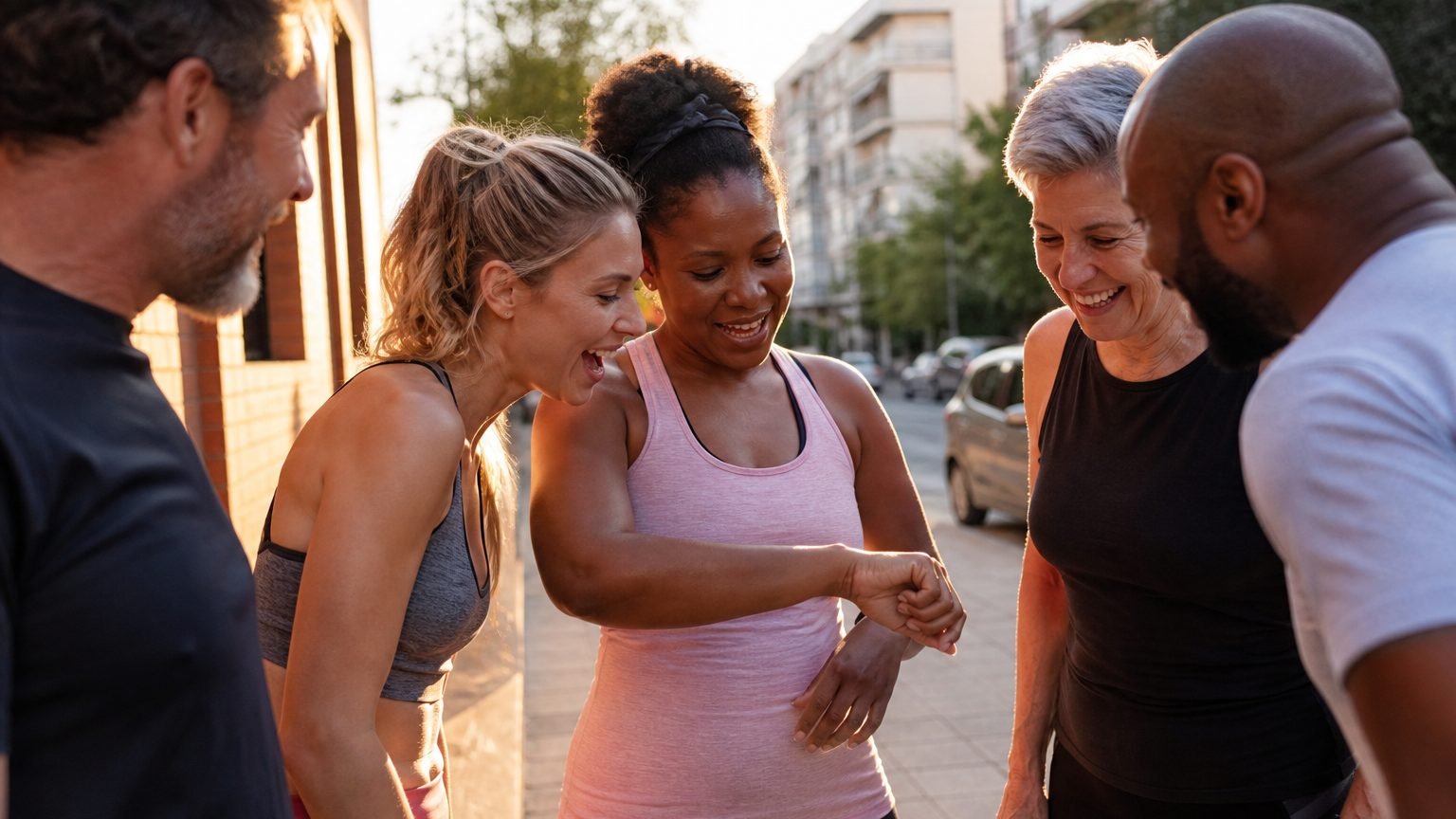
You've got the group chat ready. One friend wears an Apple Watch, another logs everything on Garmin, someone else trusts WHOOP, and the rest are split between Fitbit, Oura, Strava, Polar, or just an iPhone. The challenge should be simple. The setup usually isn't.
That friction is what competitive fitness runs into. People don't quit because they dislike competition. They quit because the leaderboard looks unfair, the devices don't match, or the rules only make sense inside one ecosystem. The fix isn't more motivation. It's making the scoring clear enough that different wearables can play by the same rules.
What competitive fitness actually means
A good fitness challenge doesn't need to look like elite sport. It needs a shared goal, a visible scoreboard, and enough structure that people keep showing up. When a friend group turns daily steps, workouts, or ring closes into a ranked challenge, that's competitive fitness in practice. It's ordinary movement with social stakes.
This is already mainstream behavior. Plenty of people pay for gym access and already track their activity on a wearable or a phone. The gap isn't interest. It's that most competition tools still assume one device family, one metric, or one habit level. That works fine if everyone owns the same watch. It falls apart the moment somebody joins from an iPhone, or a different wearable counts effort its own way.
The structure behind the scoreboard
Competitive fitness usually has three parts. There's a time window, like a weekend sprint or a weekly league. There's a scoring rule, which decides what counts. And there's a public ranking, which makes progress visible to the group.
So competitive fitness works best when it feels less like a sport tryout and more like a shared routine with a visible record. Getting people to care is the easy part. The hard part is making sure the same workout means something consistent whether it came from Apple, Fitbit, Garmin, WHOOP, Oura, Strava, Polar, or phone-only tracking.
Why social competition boosts motivation and adherence
People act differently when their effort is visible to others. A solo reminder says you should work out. A live leaderboard says your friend just moved ahead. That changes the decision in the moment, and that small shift is often what turns good intentions into a routine that holds past the first week.
The motivation problem is real and widespread. Many adults and most adolescents fall short of recommended activity levels, and that gap is as much a design problem as a willpower one. People do better with systems that make consistency easier to keep, and shared competition is one of those systems.
Comparison creates action
The strongest competitive loops stay simple. You see your rank. You see the gap. You make a move. Rank changes and gap tracking turn vague goals into specific choices you can act on today. Weekly leagues add a longer frame, so one bad day or one unusually strong workout doesn't define the whole experience.
In mixed-device groups, the fairness layer matters as much as the competition layer. Apple, Fitbit, Garmin, WHOOP, Oura, Strava, and Polar don't always measure effort the same way, so raw totals can quietly reward one device family over another. Normalized scoring is what keeps the board from feeling biased when friends bring different wearables into the same challenge.
Healthy rivalry is different from pressure for its own sake. A scoreboard only helps when the group feels connected and the scoring looks earned. If the leaderboard feels arbitrary, people stop trusting it. If it feels fair, they come back.
Common competition formats and when to use each
Not every group needs the same format. A weekend sprint works when people want a quick reset. A weekly league works when the group wants recurring structure. A monthly leaderboard works when the challenge needs enough time to fit busy schedules, teams, or workplace groups.
The right format depends on how often your group checks in. Casual friends usually respond better to a short sprint, because the finish line is close and the commitment feels manageable. Groups that already compare workouts often do better with a league, because the ranking has time to breathe.
Move Leagues place you in a fresh cohort of up to 30 people at your tier every Monday, with promotion for top finishers and demotion for the bottom few. That gives you regular competition without making a single result feel permanent, because you can always recover from one weak week. For more on how groups actually use challenges, our group fitness challenge guide is a good starting point.
Picking the right rhythm
- Weekend sprints: best for friends who want a fast, low-friction challenge and don't want to plan far ahead.
- Weekly leagues: best for groups that want repetition, rank movement, and a reason to check in more than once.
- Monthly leaderboards: best for clubs, teams, and workplaces that need a longer runway and broader participation.
People stick with formats that match their calendar, not the other way around. The invite matters too. If the link is easy to share and the challenge works across devices, more people join without needing a device-specific workaround. Format is only half the job. The other half is making sure the scoring and onboarding don't punish the friend on a different wearable.
Fair scoring and normalization across devices
This is the part most competition products skip, and it's the part that decides whether people trust the leaderboard. Raw step counts or calorie burns look tidy on paper, but they aren't automatically comparable across an Apple Watch, Fitbit, Garmin, WHOOP, Oura, Strava, Polar, or iPhone-only setup. Different sensors, different baselines, different algorithms. Without normalization, the ranking mostly rewards device choice.
MoveTogether offers seven scoring methods, and each one solves a different problem. These five cover the most common group setups:
| Scoring method | How it works | Best for |
|---|---|---|
| Ring Close Count | Points each time someone closes an Activity Ring | Apple-centric and routine-focused groups |
| Percentage of Goals | Measures progress against each person's own targets | Mixed-ability groups and fairer cross-device play |
| Raw Numbers | Sums total activity volume directly | Groups that want a simple, direct tally |
| Head to Head on steps | Scores walking volume | Step challenges and casual competitions |
| Workout Based | Counts completed workout sessions | Training-minded groups and session consistency |
How to choose the scoring method
The cleanest rule is this. If the group is mixed in fitness level or device type, start with Percentage of Goals, which scores each person against their own targets. If everyone is training from similar baselines, a more direct metric like Raw Numbers can work. If the challenge is about showing up rather than chasing a peak, ring-based or workout-based scoring tends to feel better.
MoveTogether doesn't do GPS routes and won't, so it's built around activity signals it can compare defensibly across devices. If you want a deeper look at how the trackers differ, our fitness tracker comparison is worth reading before you set up your first league.
Tracking analytics and AI coaching that adapts
Once the competition is live, the better question is often who is holding steady. The analytics that matter most show consistency, drop-offs, and recovery, not just big one-off spikes. Achievements, trend changes, streaks, and weekly reports give that view without burying the group in noise.
Keep those jobs separate. Session frequency and completion rate show whether someone is sticking with the plan. A strong competition setup shouldn't treat every metric like a score. The most useful signals are usually the plain ones: an intact streak, a stable completion rate, and a weekly trend moving the right way. Track consistency first, intensity second.
What the coaching layer adds
MoveTogether's Weekly Mo Report gives Pro users a graded recap of the week with coaching notes, so people can see how it went without digging through every session. Past You Ghost, also a Pro feature, lets someone race their own best completed week, which helps when friends are offline or the group challenge sits between events. That kind of self-competition keeps momentum going without turning every workout into a public contest.
Coach Mo adds another layer. It handles conversation, motivation, and competition strategy, and it remembers context across sessions. It offers five coaching personalities, plus a separate Roast Mode toggle that roasts your effort using your real numbers, never your body. It does not write structured sets-and-reps programming, so it works better as a competition companion than a training-plan generator. For a closer look, see our AI fitness coach overview.
Privacy and making competition inclusive
Competition gets messy when it feels like a test you didn't sign up for. That happens fast in beginner groups, older-adult groups, and comeback groups. A leaderboard can motivate one person and make another go quiet. Good design doesn't assume everyone wants the same kind of pressure.
The underserved part of competitive fitness isn't more intensity. It's better-calibrated challenge. Groups that are already less likely to meet activity guidelines, including lower-income groups and people with disabilities, are exactly where a gentle entry ramp and socially supported, fairer competition can help most. Tier-based leagues and per-person targets create a path in rather than a wall at the top.
Trust is part of the product
Privacy matters because activity data is personal, even when the challenge is casual. MoveTogether minimizes the data it collects. It does not sell your personal information, and it does not use your health and fitness data for advertising. If people don't trust the app with their activity data, they won't trust the leaderboard either.
The same logic applies to ranking visibility. Some people love seeing the gap. Others hate being exposed early. The healthiest competitive systems make room for novices, returning athletes, and people who just want to finish without embarrassment.
How to start your first cross-wearable competition
Start with the device people already use. On iPhone, MoveTogether reads Apple Health, including Apple Watch and phone-only tracking. On Android, it reads Health Connect. Fitbit, Garmin, WHOOP, Oura, Strava, Polar, and Ultrahuman share into those from their own apps, and each person picks the one tracker that counts. That gives you one invite path instead of a separate setup for each platform.
Pick the scoring method before you invite the group. If the crowd is mixed, Percentage of Goals usually keeps the ranking fairer. If the goal is a simple step challenge, use Head to Head on steps. If the group wants something habit-based, go with Workout Based. Then choose a format: a weekend sprint for low friction, or a weekly league for ongoing structure.
A few honest specifics. MoveTogether is available on iOS and Android. Pricing is simple, and Pro is $12.99/mo or $99.99/yr on Apple, and $9.99/mo or $79.99/yr on the web.
For the shortest path, send one shared link, choose one scoring method, and launch with a small group first. That keeps the first round understandable, which is usually what gets people to come back. If you want competition that feels fair instead of device-specific, MoveTogether puts Apple Health, Fitbit, Garmin, WHOOP, Oura, Strava, Polar, Ultrahuman, and iPhone-only tracking on one live leaderboard, with Move Leagues and Coach Mo to keep the habit going.
Third-party device and platform names belong to their respective owners. MoveTogether is available on iOS and Android.