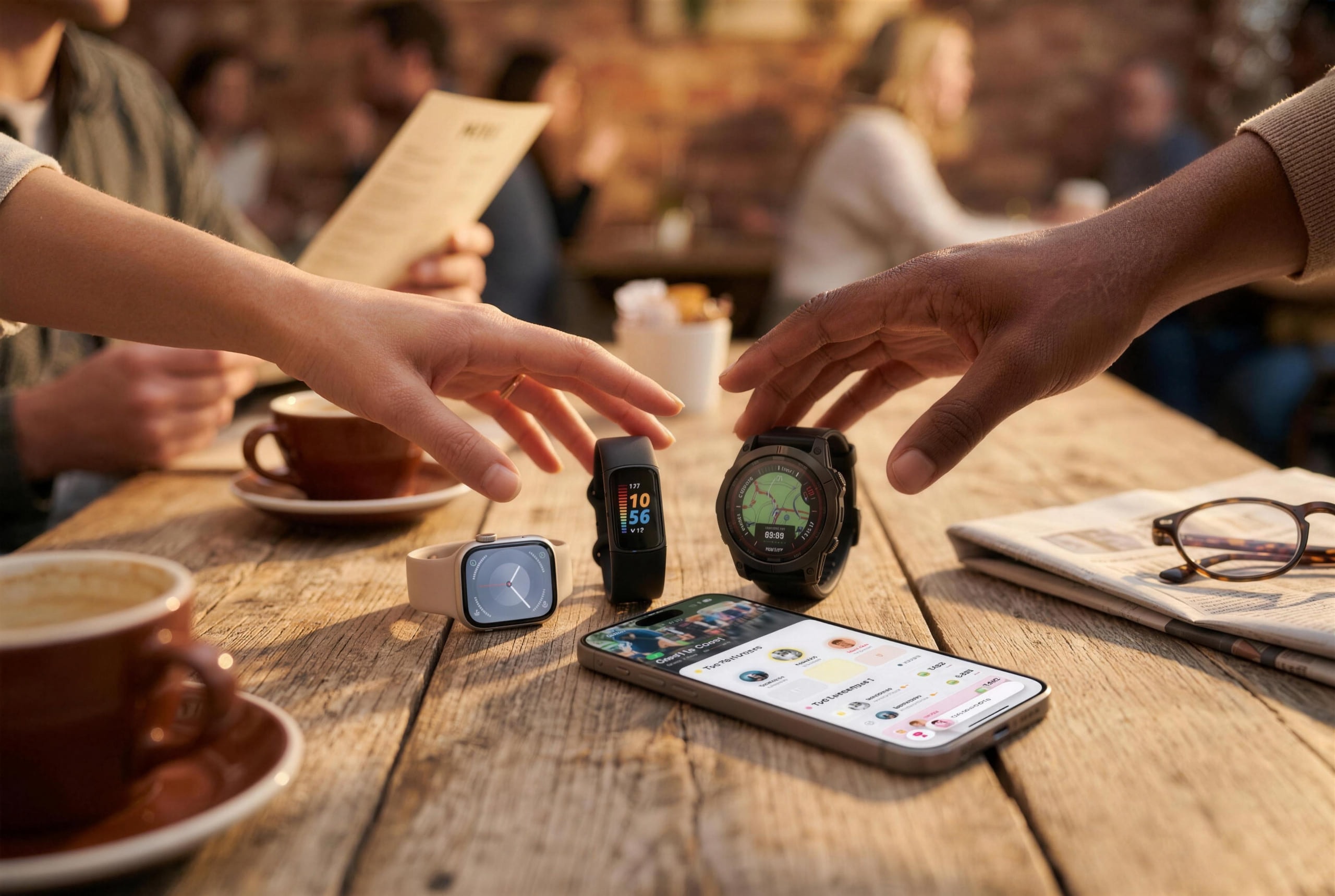
You have probably hit this already. One person in the group has an Apple Watch. Someone else has a Garmin. Another person has a Fitbit, or just an iPhone in a pocket. Everybody says “let's do a challenge,” and then nothing happens.
It is not that people don't want to train. The comparison falls apart before the training starts.
Most fitness tracker comparison articles stay at the hardware level: battery, display, GPS, sleep. That stuff matters. But if your real question is “can our mixed-device group compete fairly,” those reviews usually stop right before the useful part. That is the gap worth fixing.
The fitness competition that never starts
A normal group challenge should be easy. Pick a goal. Invite friends. Start moving. Instead, the device conversation takes over. The Apple Watch person wants Activity Rings. The Garmin user trusts Garmin Connect. The Fitbit user already has friends there. The WHOOP user cares more about recovery than steps. The iPhone-only person asks if they are excluded before the challenge even begins.
Where it breaks
Apple's sharing works well for Apple people. That is the point. It keeps rings social inside the Apple world. Garmin does the same for Garmin, Fitbit for Fitbit. These are good products doing what they were designed to do. The problem is that your friend group usually doesn't look like one product demo.
That is why so many group challenges die in the chat thread. Nobody wants to buy new hardware just to join a weekend step contest. Nobody wants to screenshot stats every night either. And nobody trusts a scoreboard if one device counts effort differently from another.
The practical issue
This isn't really about which wearable is best. It is about whether different devices can be compared without turning the whole thing into an argument. A fair challenge needs three things:
- Shared inputs. Everyone has to get data into one place somehow.
- Comparable metrics. A step, a workout, or a ring close has to mean roughly the same thing across devices.
- Simple rules. The scoring has to be easy enough that nobody needs a spreadsheet to follow it.
That is the real fitness tracker comparison problem for mixed groups. Not “which watch has the brighter screen,” but “can six friends on different systems compete without the results feeling fake?” If that is your use case, you don't need to force everyone into one ecosystem. You need a way to compare what they already use.
Why a mile on a Garmin isn't a mile on a Fitbit
The hard part isn't just collecting data. It is that the data doesn't start out equal. A Garmin, Fitbit, Apple Watch, WHOOP, and Oura don't measure movement the same way. They use different sensors, different assumptions, and different formulas. Even when two devices show the same label, the number behind it can come from a different model.
Same activity, different math
Take a brisk walk. One device leans heavily on wrist motion. Another blends heart rate and accelerometer data. A third infers effort from patterns partly tuned for the brand's own coaching features. That is why “just sync everything together” doesn't solve fairness by itself. You can centralize unequal inputs and still end up with an unfair leaderboard.
It gets messier with higher-level metrics. Recovery, readiness, strain, and body-battery style scores are built for each company's own app. In our experience they are not interoperable: an 80 on one brand is not an 80 on another, because each device scores against its own baseline using its own formula. You cannot rank them side by side and call it fair.
Accuracy isn't the same as interoperability
A device can be good at what it does and still be hard to compare fairly against another device. Research on wearable performance shows why normalization matters. A living umbrella review of wearable-accuracy studies found that wearables overestimate VO2 max by about 15.24% during resting tests and 9.83% during exercise tests, and that physical activity intensity measurements carried a mean absolute error ranging from 29% to 80% depending on the intensity. Raw cross-device comparisons get messy fast.
If a competition depends on brand-specific scores, it usually isn't fair for a mixed-device group.
What normalization actually means
Normalization sounds technical. In practice it just means translating different device outputs into a common scoring language. It is like converting currencies. You don't pretend dollars and euros are identical. You use a consistent conversion so the comparison holds up. That is the job in mixed-wearable competitions too. Not proving one brand is wrong, just acknowledging they speak different languages and comparing them on terms that survive the trip.
For people bringing in Fitbit data specifically, that distinction matters in any Fitbit connection. The sync is only the first step. The fair part comes from how that data gets interpreted against other ecosystems.
Meet the fitness tracker contenders
A mixed-device challenge usually falls apart before day one for a simple reason. One person has an Apple Watch, another trusts Garmin, someone wears a Fitbit, and at least one person wants to join with just a phone. If the group picks a winner based on whichever brand score looks best in its own app, the argument starts early. The useful question is not “which tracker is best?” It is “which tracker gives us data we can compare without a brand loyalty contest?”
Apple Watch
Apple Watch works well for iPhone users who want one device for health tracking, messages, and daily prompts. The Activity Rings are familiar, and familiarity keeps people engaged. The trade-off is that Apple's social experience makes the most sense inside Apple's own system. That is fine for an all-iPhone group. It gets harder once Android users or non-Apple wearables join.
Garmin
Garmin is built for people who care about training. Runners, cyclists, hikers, and triathletes tend to like the depth: more workout detail, more sport modes, more post-activity analysis than a casual user needs. That depth can distort a casual group challenge if nobody agrees on which metric matters. Richer activity data does not automatically mean a Garmin user should win a steps contest.
Fitbit
Fitbit is still one of the easiest trackers to recommend for everyday group use. It is simple, familiar, and usually easier for a new user to stick with than a more technical device. A tracker that gets worn every day beats a more advanced one that sits on a charger or gets abandoned after two weeks. For office challenges, family groups, and beginner-friendly competitions, Fitbit often wins on consistency.
WHOOP and Oura
WHOOP and Oura focus on recovery, readiness, and sleep trends more than on basic step counting. That makes them useful for people who care about how recovered they are before training. It also makes them harder to compare fairly in a mixed group. Their headline scores are product-specific interpretations, not universal units. If one person competes on strain, another on steps, and another on active calories, the group is no longer comparing the same thing.
iPhone-only and Strava-linked users
Phone-only participants are common in real challenges. So are people who care more about Strava than the device on their wrist. Treating them as edge cases is a mistake. In most friend groups, schools, workplaces, and family competitions, they are part of the group from the start. Any system built for fair competition has to account for that. A wearables support overview is a good starting point, because the practical question is less about hardware bragging rights and more about who can join without breaking the scoring.
Comparing trackers for group competitions
If the goal is fair competition, three criteria matter more than most review sites admit. Can the data be accessed cleanly? Which core metrics are usable for comparison? And how tightly does the ecosystem pull you back into its own app and scoring logic? The short version:
| Tracker | Data access | Best for | Ecosystem lock-in |
|---|---|---|---|
| Apple Watch | Strong through Apple Health | iPhone users who want rings and smartwatch features | High if the group relies on Apple-only sharing |
| Fitbit | Straightforward for common activity metrics | Beginners, families, and step-based challenges | Moderate |
| Garmin | Strong for workout and endurance data | Athletes who care about training depth | Moderate to high |
| WHOOP | Best treated carefully in mixed comparisons | Recovery-focused users | High |
| Oura | Useful for sleep and recovery context | Low-profile wear and recovery trends | High |
Data access matters more than feature lists
This is the unglamorous part, but it decides whether a group challenge works. If data can't be read consistently, the rest is moot. Apple Watch data is powerful because Apple Health can collect from the watch, from iPhone-only activity, and from a lot of other apps. Fitbit and Garmin are common enough that people expect them to work with third-party services. WHOOP and Oura usually enter the conversation because users love their own dashboards and want to bring some of that data into a broader competition. The trouble starts when people assume all exported data is equally comparable. It isn't.
Core metric strength by use case
For mixed-device competitions, simpler metrics usually hold up better.
- Step count is often the easiest metric for broad participation.
- Workout Count scoring helps when the group cares more about completed sessions than passive movement.
- Ring-style progress is good for habit consistency, especially for Apple users.
- Recovery scores are interesting for personal coaching and weak for direct mixed-brand competition.
Steps have a quiet advantage here. Step counting is one of the few metrics people already understand, trust, and will check daily, so a step-based leaderboard gets stronger the moment the input metric is stable and familiar. That doesn't make Fitbit the winner for every group. It means the format is only as fair as the metric underneath it.
Lock-in is a social problem
People talk about lock-in like it is only technical. It is social too. If your whole friend circle already shares Apple rings, switching feels annoying. If you have built your training life inside Garmin, you don't want to abandon it. If WHOOP or Oura gives you the recovery narrative you like, you will keep opening those apps first. That is normal. A good competition setup doesn't fight it. It works around it.
For a practical look at that reality, this guide on competing with friends on different wearables gets into the day-to-day trade-offs.
How we make it fair for everyone
A mixed-device challenge falls apart fast when one person's watch measures effort one way and another person's ring measures something else. Fair scoring starts with a simpler rule: compare people on metrics that survive the trip across brands. So the system reads data from Apple Health, Fitbit, Garmin, WHOOP, Oura, Strava, and Polar, then scores the parts those platforms can report in a way a group can understand. The goal is not to flatten every tracker into the same product. It is to give everyone a scoreboard that feels believable.
The seven scoring methods
These are the methods that hold up best in real groups.
- Ring Close Count is best for consistency challenges. It rewards daily follow-through more than raw output, which suits groups that care about habit building.
- Percentage of Goals is usually the fairest choice when fitness levels are far apart. Each person competes against a personal target, so the strongest athlete doesn't win by default.
- Total Activity is useful when the group wants a simple leaderboard that adds up calories, minutes, and steps. Simplicity is high, precision across brands is lower.
- Workout Count is better for training groups that want to reward intentional exercise sessions instead of incidental movement through the day.
- Personal Goal lets the host set a goal range. Each person picks their own target inside it and scores 100 for every day they hit it. Hosting needs a Membership; joining is free.
- Stick To It sets one daily goal in steps, calories, or exercise minutes, and each day you hit it earns a point. It rewards consistency, not a leaderboard race. Hosting needs a Membership; joining is free.
- Head to Head races on one number, and the highest total wins. The host picks steps, which most devices track well enough for casual competitions; active calories, a pure output race for groups with similar fitness levels; or exercise minutes, which travel well across brands because every platform reports exercise time in some form.
What we avoid
We don't build shared competitions around vendor-specific scores such as recovery, readiness, or strain. Those scores can help inside the app that created them. They are much weaker once you try to rank Apple, Garmin, Oura, WHOOP, and Fitbit users on the same board. Richer metrics often feel more personal, but they are harder to compare fairly across brands. Simpler metrics travel better. The fairest leaderboard is usually the one with the least magical math in front of the user.
Coach Mo helps with accountability, motivation, and challenge strategy. It doesn't try to replace a full training program, and that is a deliberate choice. For mixed-device competitions, the job is to keep people engaged and make the scoring clear enough that nobody argues about the rules more than the workout.
Choosing your tracker based on price and privacy
A lot of fitness tracker comparisons stop at hardware price. That is not enough. The total cost is hardware plus whatever the company keeps charging you for access to features you thought you already bought.
The subscription question
Core features are increasingly locked behind monthly fees. Engadget's roundup of trackers without a subscription points out that WHOOP requires an active membership to work at all, and that a chunk of Google's Fitbit features sit behind Google Health Premium, a hidden long-term cost that first-pass hardware reviews miss. That doesn't make subscription-first products bad. It changes the buying decision. If WHOOP or Oura's recovery framing helps you train smarter, the fee may be worth it. If you want a simple family challenge tool, recurring fees can feel like friction you didn't sign up for.
Price is really about commitment
Ask a different question before buying. Not “what can this tracker do on day one,” but “what am I still paying for six months from now, and do I still care?” That question usually filters the options quickly.
- If you hate recurring fees, lean toward ecosystems that stay useful without a subscription.
- If you want deep recovery framing, a subscription model may still make sense.
- If your group only needs fair competitions, don't overbuy a device for metrics nobody in the challenge will use.
Privacy is part of the comparison
Wearables collect intimate behavior data: sleep timing, movement patterns, workout habits, sometimes location. That means privacy shouldn't be a side note. It should be part of the purchase decision. We prefer a boring privacy model, which is why the pricing page is plain about how the product makes money. When the business model is clear, the product has less incentive to get weird with your data. MoveTogether is available on iOS and Android.
Our recommendations for your use case
Start with the competition, not the device. If your group keeps stalling because one person has an Apple Watch, another uses Garmin, and someone else only wants to carry a phone, the best tracker is the one that gives you reliable data without making the scoring argument worse. Hardware matters. Fairness matters more.
Apple Watch is the easy pick for iPhone users who want a watch they will wear all day. It does enough for casual challenges, and the experience is smooth if you already live in Apple's ecosystem. The trade-off is price, battery life, and a setup that makes the most sense when everyone is on iPhone.
Garmin fits people who train on purpose. If pace, distance, heart rate zones, and workout detail matter, Garmin usually gives more than a casual tracker. The trade-off is that it can be more device than a social step challenge needs, and mixed-device groups still need a fair way to compare results.
WHOOP and Oura make sense for people who care most about recovery, readiness, and long-term behavior patterns. They are useful tools. They are not the cleanest foundation for a cross-brand leaderboard, because their best-known scores are built differently from brand to brand.
Fitbit is still a practical middle option. It is easier for many people to start with, less intimidating than a performance watch, and good enough for everyday movement challenges. And if someone in the group doesn't want to buy anything new, iPhone-only tracking is enough to take part.
That is the core recommendation. Pick the device you will keep using after week one, then use a competition system that normalizes the differences instead of pretending they don't exist. If your group wants fair competitions across different devices, MoveTogether reads Apple Health, Google Health/Fitbit, Garmin, WHOOP, Strava, Polar, Oura, Ultrahuman, and iPhone-only activity onto one live board. Use what you already have, and check the comparison library to see how common setups line up before you choose.