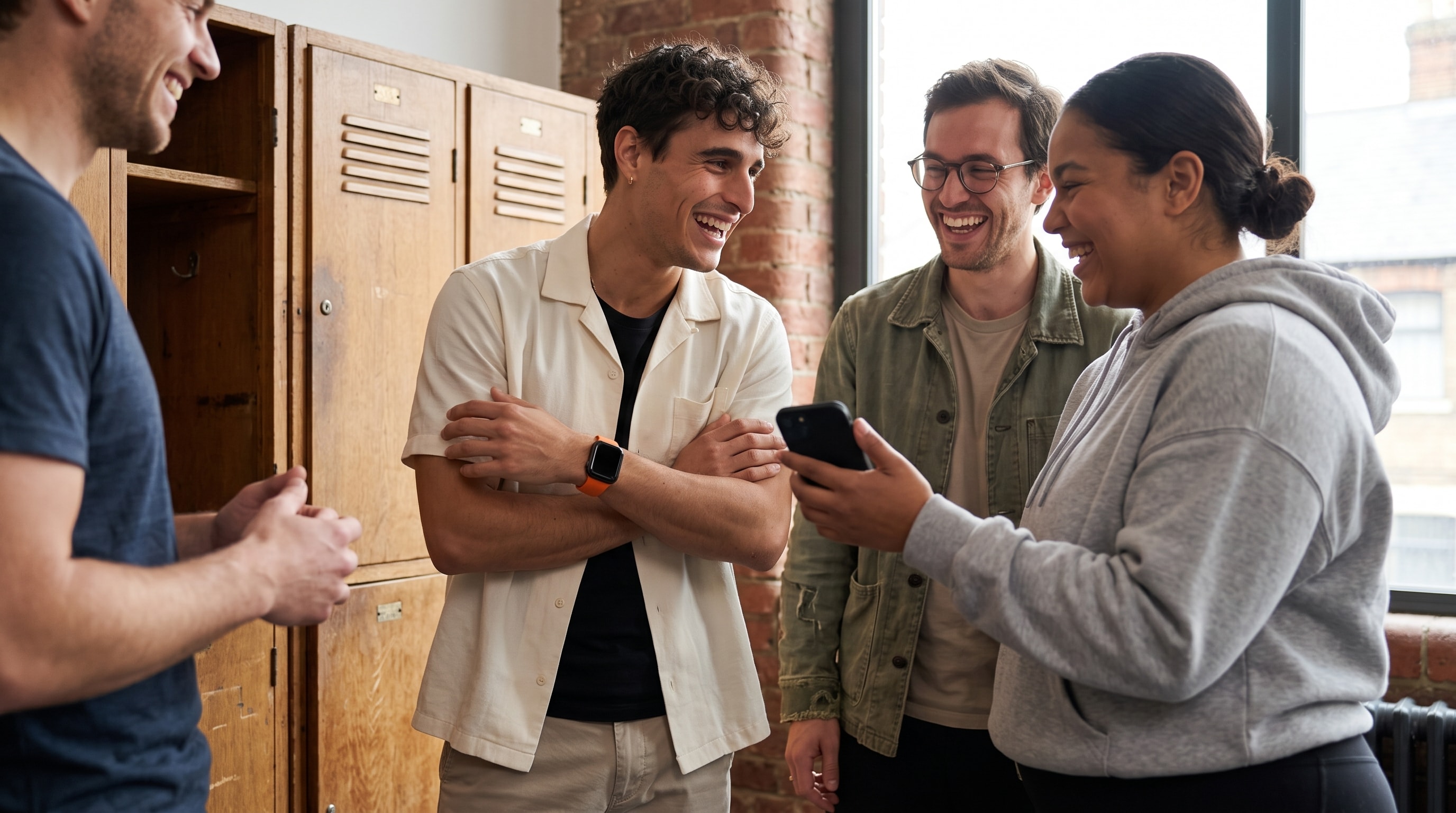
You want to run a fitness challenge with friends, but everyone has a different watch. One person has an Apple Watch. Another uses Garmin. Someone else is on Fitbit. Then there is the friend who only tracks on an iPhone. Most apps make that awkward fast.
That is the problem we built MoveTogether to solve. It reads activity from Apple Health, Fitbit, Garmin, WHOOP, Oura, Strava, and Polar, then puts everyone on one live leaderboard with scoring you can see. Nobody switches devices. Nobody gets left out.
That matters because inactivity is still widespread. The World Health Organization reports that 31% of adults worldwide, about 1.8 billion people, did not meet recommended physical activity levels in 2022, against a guideline of at least 150 minutes of moderate-intensity activity per week (WHO physical activity fact sheet). Daily challenges work best when they make showing up simple, social, and fair across whatever devices people already own.
Below are eight daily challenges you can run in MoveTogether. Some suit competitive groups. Some fit beginners, people coming back from a layoff, or mixed-ability teams. The hard part is never the clever name.
1. Activity ring close challenges
This is still the cleanest daily format for mixed groups. Close your rings. Do it again tomorrow. Everyone understands it in seconds. In MoveTogether, ring-based competitions work because Move and Exercise progress is normalized across ecosystems into one fair contest, so Apple Watch users are not stuck in their own lane and people on Garmin, Fitbit, WHOOP, or Oura still compete on the same board.
Why ring challenges stick
A ring close challenge rewards consistency more than one huge workout, and that is the point. Most groups do not fail because nobody can train hard. They fail because two people go all in on Monday and vanish by Thursday. Set realistic daily goals before the competition starts, then let the live board do the work. Ring goals should be a shared floor for showing up, not a punishment for the people who miss one.
This also feeds your weekly Move League, where consistent daily ring completion adds up to a better weekly placement. If you are not sure whether to rank people by straight ring closures or by progress against their own goals, our breakdown of Percentage of Goals versus Apple's Move ring is the right place to start. Score it on Ring Close Count for a straight consistency race, or Percentage of Goals when baselines vary a lot.
- Best for friend groups: daily bragging rights without forcing everyone into the same workout style.
- Best for workplaces: shareable invite links keep setup short.
- Best for busy schedules: Coach Mo can nudge people with simple tactics to close rings on chaotic days.
The trade-off is obvious. Ring challenges are broad, not sport-specific. If your group wants GPS route maps or run splits, keep using Strava for that. MoveTogether reads Strava activity, but it does not do GPS routes and is not trying to.
2. Step count sprint challenges
If you need the lowest-friction option, use steps. People do not need a gym plan or a lecture on training zones. They just need to walk more than usual. That simplicity matters because daily participation is low in practice. In the United States, only 19.31% of the population was engaged daily in sports, exercise, and recreation on average between 2010 and 2022, according to PTPioneer's fitness industry statistics. A step sprint meets people where they already are.
How to make a step challenge fair
Step challenges work well for families and community groups because a step is easy to explain. The hard part is fairness. Different devices collect and sync data differently, and mixed-device competitions lose trust fast if people think one tracker gets credit too easily. MoveTogether normalizes incoming data across supported sources and recalculates the board as new sync events land, so a Fitbit walker and an Apple Watch walker show up in the same race.
A few patterns hold up better than others:
- Use a shared daily target when you want broad participation instead of a single winner.
- Use all-out sprints sparingly. A hard weekend is fun. A month of step maxing gets old.
- Watch trends, not just wins. On Pro, the Weekly Mo Report helps you spot when someone starts strong and fades.
More people finish a challenge that asks for repeatable walking than one that quietly turns into an arms race. Score it on Head to Head on steps and keep the window short, and Coach Mo can help with pacing so people do not burn all their steps by noon and stall.
3. Workout frequency daily challenges
Some groups do not want to compare steps or ring progress. They want one rule: do a workout today. This suits gym crews, home workout groups, and remote teams that want accountability without arguing about intensity. You showed up, and that counts. In MoveTogether, the practical way to score this is Ring Close Count, since closing your Exercise ring stands in for the session, whatever the workout was.
Where this works, and where it does not
Workout frequency challenges shine when people train in different ways. One person lifts, another rows, another does yoga, another logs a long walk. They stay in the same challenge. It is also kind to people rebuilding after injury or burnout. A lot of social-media challenge formats skip scaling and modification, and NBC's look at 30-day challenges points out that beginners often need step-by-step scaling, like a knee plank before a full plank, plus breathing guidance and a single-focus cardio option rather than a grab bag of moves (NBC on 30-day fitness challenges). A frequency challenge sidesteps a lot of that because it rewards completion, not a fixed advanced movement.
- Use it for rehab-minded consistency. “One session today” is usually more sustainable than “beat yesterday.”
- Use Roast Mode carefully. Roast Mode adds playful accountability, but know your group. Some people love it, some do not.
- Celebrate in the feed. Pro users can react to workouts and keep momentum alive between sessions.
The weakness is that it flattens effort. A short recovery session and a long training session both count if any workout counts. That is a choice, not a bug. If your group cares about volume, pair this with ring or step tracking so the board still reflects output.
4. Weekend sprint competitions
Friday night, half the group has done nothing. By Sunday afternoon the board moves every hour. That is why weekend sprints work. They create urgency without asking for a month-long commitment, which fits friend groups, gym communities, and remote teams that want one shared event instead of another challenge people forget by week two.
Short windows force better setup. Pick one metric and make the scoring obvious. Head to Head on steps is the easiest for mixed-device groups. Ring closes work if everyone already wears a ring-based device. Create a Friday-to-Sunday competition, choose one scoring model, and keep the leaderboard live so people can react in real time. If your group likes this rhythm week after week, a repeating competition saves you from rebuilding it each Friday.
There is a trade-off. Weekend sprints can favor people with free Saturdays or long cardio habits. That is fine for a high-output contest. If you want broader participation, use Percentage of Goals so one huge Saturday session does not decide everything by noon. Data quality also matters more here than in a month-long challenge: one delayed sync can swing a short race, so it is worth checking that everyone's device is connected before the window opens.
5. Daily activity that feeds a weekly Move League
Monday starts well. By Wednesday the same two people are pulling away and everyone else stops checking the board. A flat, month-long leaderboard gets predictable fast. Move Leagues fix that by resetting the competition every week, so a bad day never buries you for a whole month.
How Move Leagues actually work
Move Leagues are not a challenge you configure by hand. Every Monday, MoveTogether drops you into a fresh cohort of up to 30 people at your tier. You climb ten tiers from Walker to Legend: the top finishers promote, the bottom finishers demote, and one demotion protection in the bank absorbs a single rough week. It is included on every account, no Pro requirement.
Scoring is fixed and goal-independent, which is what makes it fair across devices. Your weekly score is Move calories plus Exercise minutes plus a step contribution, summed across the seven days, so you cannot out-rank someone by setting easier targets. That is why the daily habit is the whole game here. Closing rings and getting your steps in on an ordinary Tuesday is exactly how you climb, and it works the same whether you are on an Apple Watch, a Garmin, a Fitbit, or an iPhone alone.
One thing to know going in: league cohorts are usually strangers at your level, not your friends, by design. If you want a daily race scoped to your own friend group, use the Friends leaderboard for that and let the league be your weekly ladder against people at your pace.
6. Personal milestone and streak challenges
Not every daily challenge should be public. A lot of people need consistency before they need competition. That is where streaks come in. Close your rings for consecutive days. Hit your step target every day this week. Those are quiet wins, but they are often the ones that stick.
Streaks work when the bar is realistic
The common mistake is setting the streak target too high. People pick a standard they can hit only on ideal days, then one rough day breaks the streak and the whole thing collapses. A better streak has slack built in. Streaks & Shields handles that: close at least one ring a day and your streak ticks up, and a Shield you have earned deploys automatically on a missed day instead of dropping you to zero. Missing one day should change the next day's plan, not end the whole story.
Coach Mo helps here because it can respond to what happened instead of acting like one missed day means the plan is dead. This is a good format for beginners, people returning from injury, and teams where not everyone wants a public leaderboard. You can still share progress in group chat on Pro, but the challenge stays personal enough to feel manageable.
7. Themed weekly challenges with configurable scoring
A team starts strong on Monday. By Wednesday, half the group is asking what counts and whether the scoring favors Apple Watch users or the friend who logs every workout by hand. Themed weeks only work when the rules are clear before day one. MoveTogether gives you seven scoring methods, so match the theme to the method and the week feels fair instead of arbitrary.
Pick the scoring method that fits the behavior you want
Use Percentage of Goals when the group has mixed fitness levels or mixed devices, because it rewards people for hitting their own targets rather than for having the highest baseline. Use Head to Head on steps for walking or cardio weeks where volume is the point. Ring Close Count is your consistency week, and Total Activity works when the group accepts a simple total and does not need much normalization. Keep the scoring logic steady once the week starts. Comparison gets shaky the moment the method shifts underneath people.
A few setups that hold up:
- Cardio week: Head to Head on steps or Total Activity
- Consistency week: Ring Close Count or Percentage of Goals
- Mixed-motivation group: Percentage of Goals
The trick that cuts off most fairness complaints: publish one line with the theme, one line with the scoring method, and one line with what does not count. If you want better prompts and check-ins during the week, our guide to the AI fitness coach inside MoveTogether covers how Coach Mo keeps a challenge focused without changing the scoring midstream.
8. Racing your Past You Ghost
The Past You Ghost is for the person who likes competition but does not always want to coordinate with six friends. Your best completed week becomes the opponent, and you try to beat it. This is a MoveTogether Pro feature, and it is one of the most useful ones for people with uneven schedules. You do not need everyone online at once. You just need your own history.
Self-competition can be more honest than group competition
A live ghost race solves a real problem. Group challenges motivate, but they are noisy. Travel, work, illness, and family schedules all distort the comparison. Racing your own best week strips most of that away, as long as the comparison stays consistent from one week to the next. Your toughest rival is usually your own best normal week, not a friend's freak outlier day.
Coach Mo adds the part that makes this fun instead of clinical. It can narrate how you are tracking against your own pace, where you are ahead, and where you are slipping. Not with sets-and-reps programming, which is not what Coach Mo does. It handles conversation, motivation, and competition strategy. Pair Past You Ghost with Streaks & Shields and the Weekly Mo Report, and you get a daily challenge that stays personal without feeling isolated.
The eight formats at a glance
| Challenge | Suggested scoring | Best for | Watch out for |
|---|---|---|---|
| Activity ring close | Ring Close Count | Mixed groups who want daily consistency | Broad, not sport-specific |
| Step count sprint | Head to Head on steps | Beginners, families, low-friction walking | Rewards volume over effort |
| Workout frequency | Ring Close Count | Gym crews, rehab, remote teams | Flattens effort across session types |
| Weekend sprint | Head to Head on steps | Busy groups who want one shared event | Favors free Saturdays; sync gaps sting |
| Weekly Move League | Move Leagues | Groups wanting a recurring weekly ladder | Cohorts are strangers at your tier |
| Milestones and streaks | Ring Close Count | Beginners and low-pressure participants | Too high a bar breaks the streak |
| Themed weekly | Percentage of Goals | Groups that want variety with fair rules | Changing the method mid-week loses trust |
| Past You Ghost (Pro) | Past You Ghost | Solo motivation on an uneven schedule | Can tip into chasing only your peak |
Start your first challenge today
By day four, daily challenges usually fail for boring reasons. The rules were fuzzy. The scoring felt off. Someone's watch synced late. Someone else never understood what counted. Set up your first challenge to survive that reality.
Start small. Pick one metric and one scoring rule. For a mixed-device group, activity ring close and step count sprints are the safest first options because everyone understands them fast. If your group cares more about consistency than output, use workout frequency. If people want a personal target with less social pressure, use streaks, milestones, or the Past You Ghost. Run a seven-day test first, then adjust the scoring based on what actually happened in your group, not what sounded fun at setup.
A couple of product limits matter too. MoveTogether is available on iOS and Android. iPhone and Android friends compete on the same leaderboard. MoveTogether is not trying to replace Strava, Garmin, Fitbit, or Apple's training views. Those still handle workout logging well. MoveTogether handles the shared challenge layer across different wearables.
Keep the launch simple. Check pricing, invite a small group, write the rules in one short message, then watch the first couple of days and fix confusion fast. MoveTogether gives mixed-device groups one place to run daily challenges with fair scoring, connected wearables, and a clear leaderboard.
Third-party device and platform names belong to their respective owners. MoveTogether is available on iOS and Android.