A sore knee makes rest sound sensible. Then rest turns into stiffness, weaker legs, and less confidence the next time you try to move. That loop is familiar, and it usually leaves the knee less tolerant over time, not more.
The modern evidence points the other way. A 2025 network meta-analysis in The BMJ pooled 217 randomized trials and more than 15,000 people and found that aerobic exercise belongs near the front of the line for knee osteoarthritis, with walking, cycling, and swimming among the options most consistently linked to less pain and better function. For bad knees, the right low-impact cardio is not a consolation prize. It is the treatment a lot of people already needed.
This is a practical guide to doing that without feeding the pain: which cardio is genuinely easy on the joint, how to dose it, and how to tell productive effort from a flare. It is not medical advice. If your knee has a specific diagnosis or recent surgery, treat what follows as a starting point for a conversation with your clinician, not a replacement for one.
Why moving usually helps a sore knee
The old advice was cautious to a fault: be careful, rest it, maybe it will settle. The problem is that a knee which stops moving tends to get stiffer and weaker, and a weaker leg has less margin the next time you ask it to do something.
The point is not to push through pain. It is to pick a cardio mode that lets the joint move without the repeated impact that tends to set symptoms off. Low-impact cardio keeps your heart and lungs working while the knee gets a quieter mechanical environment.
A simple rule sorts most of it out. If an activity leaves you looser and more functional once you have recovered, it is doing useful work. If it repeatedly leaves you more swollen, more guarded, or more afraid to move, it is the wrong dose or the wrong movement for you right now.
Different knees also want different things. Osteoarthritis often tolerates steady, rhythmic motion well. Pain at the front of the knee usually prefers a smoother arc with less deep bend and less load on the kneecap. A meniscus history or a post-surgical knee tends to do better with options that limit twisting, impact, and sudden changes of direction while still letting the leg work. The activity that suits one of those can annoy another, which is why “low impact” on a label is not the whole answer.
What makes cardio low impact, and why it matters
Low-impact cardio is really about joint loading. Some workouts drive force through the knee with every step or landing. Others remove your body weight from the equation or spread the force through a controlled motion. That difference changes how the joint feels during the session and how it responds the next day.
Weight-bearing versus non-weight-bearing
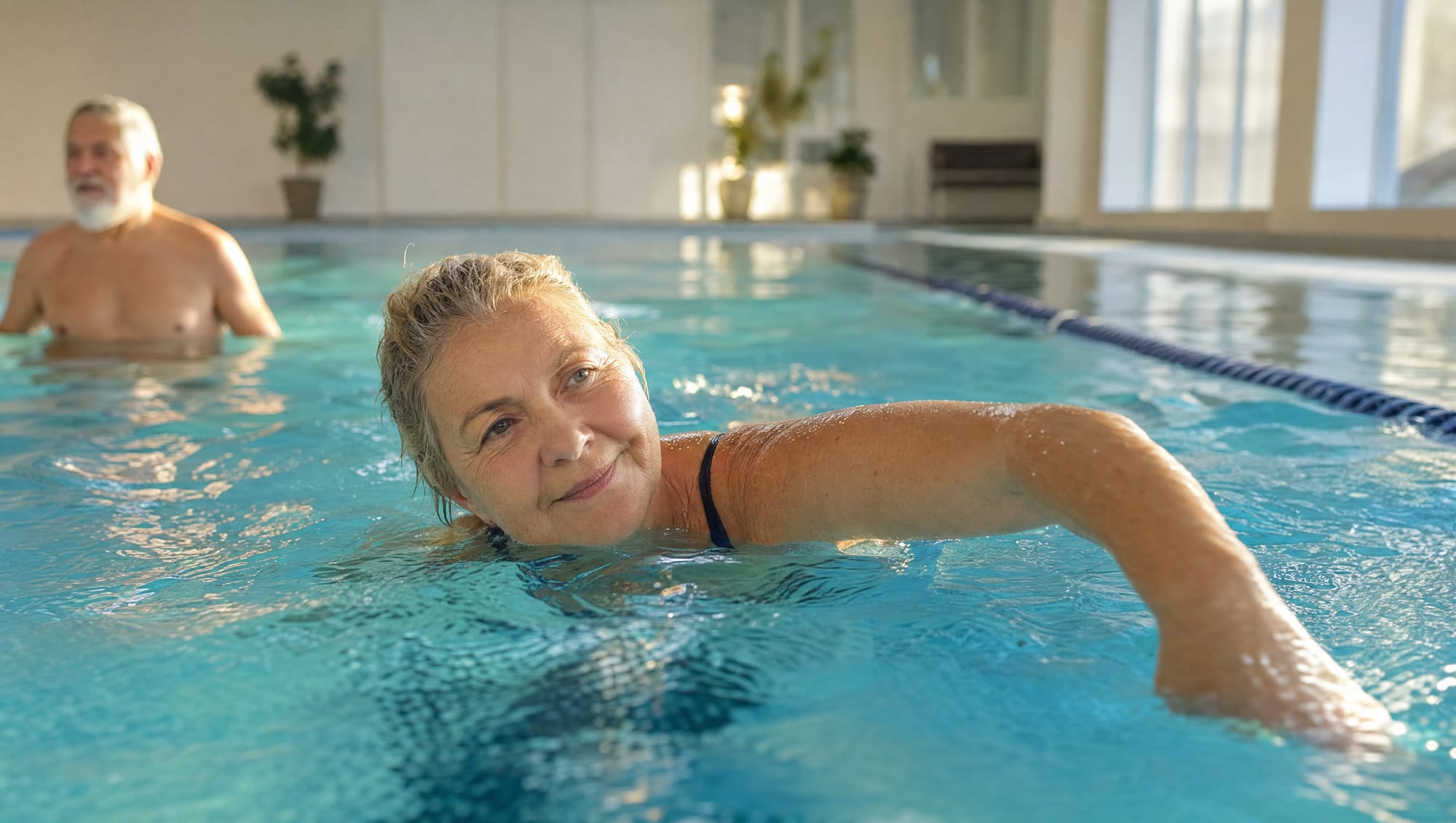
Swimming and water aerobics are the clearest non-weight-bearing options. In water, buoyancy does a lot of the work, so you can raise your heart rate while the knee absorbs far less repetitive load than it does on land. That is a big part of why the BMJ review landed on water-based exercise as one of the gentler, effective choices.
Cycling, the elliptical, and rowing sit a step over from that. They are still low-impact because they cut out the jarring landing phase of running or jumping, but they keep the legs moving through a repeated pattern. That is useful, because an irritated knee often tolerates controlled motion better than impact.
Low impact does not mean no stress. It means the stress is usually more controlled and easier to dial in. A machine labeled knee-friendly can still flare symptoms if the resistance is too high, the session runs too long, or the cadence is too aggressive. The dose matters more than the label.
The safest low-impact cardio options for knee pain
The best choice depends on which knee problem you are dealing with and what your body tolerates today. How the common options compare:
| Exercise | Best for | Watch out for | Joint load |
|---|---|---|---|
| Swimming | Most knee pain, especially sore or swollen joints | Breaststroke can bother some knees | Very low |
| Water aerobics | Arthritis, stiffness, easing back into activity | You need pool access | Very low |
| Cycling | Osteoarthritis, front-of-knee pain, stiffness | Seat height and resistance still matter | Low |
| Recumbent bike | Sensitive knees, balance issues, gentle starts | Can still bite if resistance climbs fast | Low |
| Walking | General fitness, getting back into cardio | Pace, slope, and surface can flare it | Low to moderate |
| Elliptical | People who want weight-bearing without impact | High resistance or cadence can aggravate | Low to moderate |
| Rowing | People who tolerate a deeper knee bend | The catch position can bother front-of-knee pain | Low to moderate |
| Chair-based cardio | Flare-up days and very low-tolerance days | Intensity is limited | Very low |
Matching the option to the knee
For osteoarthritis, steady cycling or walking often works, because both keep the knee moving without the shock of impact. For pain at the front of the knee, bike fit matters a lot, and a recumbent bike can feel easier because it lowers the balance demand and lets many people control the range more comfortably. For a meniscus history or a recent surgery, water work often makes sense early, since it buys motion without forcing the joint to carry your body weight. If stiffness is the main complaint, a smooth, predictable pattern usually beats anything explosive or twist-heavy.
A good rule of thumb: pick the option that lets you breathe hard enough to get an aerobic benefit without making the knee feel more irritated each day. If you want a broader mix once you have a base, our cross-training guide lays out how to rotate modes without overloading one joint.
How to build a plan that ramps
The temptation is to jump straight to the headline number. Standard physical-activity guidance points to roughly 150 minutes a week of moderate activity for most adults, and that is a fine target to aim at. It is a bad place to start from a cranky knee.
Start below the target, then earn your way up
A safer ramp keeps the first steps boring on purpose. The knee usually tolerates one change at a time better than two at once, so add time or add a day, not both.
- Weeks 1 to 2: 15 to 20 minutes, three days a week, at a conversational pace.
- Weeks 3 to 4: move to about 25 minutes per session, or add a fourth day. Pick one.
- Week 5 and on: build gradually toward 30 minutes most days, as tolerated.
Short sessions count too. A brisk 10-minute walk still adds to your week, which helps on busy days and flare-up weeks. Two or three short walks can be easier on the joint than one long push, even when the weekly total is the same.
The useful signal is the next morning. If a session feels fine while you do it but the knee is noticeably angrier the day after, the dose was too much for now. Back it off a notch and try again in a couple of days rather than repeating the same session and hoping.
Warm-up, cool-down, and reading the pain
A lot of knee trouble comes from what happens around the workout, not just during it. A body that starts cold moves stiffly, and a body that stops abruptly can stay tense longer than it needs to.
Warm up like the knee needs a handshake
Give yourself 5 to 10 minutes of easy movement before you load the joint. Marching in place, a slow walk, or seated leg circles raise blood flow and make the knee feel less abrupt when the real work starts. The point is not to tire yourself out. It is to signal that motion is coming. The same logic behind a dynamic warm-up for running applies here even when the main event is a bike or a pool.
Cool down and watch the symptoms
Ease back to rest rather than slamming to a stop, and keep any stretching gentle. Seated hamstring and quad stretches that avoid deep knee bend are usually enough. If a stretch feels sharp inside the joint, it is too much.
Learn the difference between muscle soreness and joint pain. Muscle soreness is usually dull, spread out, and fading within a day or two. Joint pain tends to be sharper, more localized, and more stubborn. If symptoms are clearly worse 24 hours after a workout, make the next session smaller. If swelling shows up, ice after activity can help settle it.
Strength work belongs in the picture too. Standard guidance recommends at least two days a week of muscle-strengthening alongside your cardio. Stronger muscles around the knee do not erase pain, but they do lower how much load the joint has to manage during everyday movement.
Tracking low-impact cardio with MoveTogether
Consistency gets easier when progress is visible, and that matters more with a bad knee, because careful, shorter sessions can feel like they are not adding up when they actually are. MoveTogether is built for that kind of tracking, and it works across the devices people already wear.
Log the activity you can actually tolerate
MoveTogether reads Move, Exercise, and Step data from Apple Health, Google Health/Fitbit, Garmin, WHOOP, Strava, Polar, Oura, Ultrahuman, and iPhone-only tracking, then normalizes it so different devices land on the same leaderboard. That is useful when one person does water aerobics, another cycles, and a third just takes shorter walks. Everyone can compete fairly without being pushed onto the same hardware.
You can join a Move League for weekly accountability, or run a competition when you want a more direct nudge. If you are still sorting out what your devices can feed in, the wearables page lays out what is supported.
Pick a scoring style that fits gentle cardio
Knee-friendly training rarely looks like one neat metric, so the scoring method you choose matters. For a walking-based routine, Head to Head on steps keeps it simple. If your effort is spread across cycling, swimming, and short walks, Percentage of Goals compares each person to their own targets, which is the fairest option when people are working at very different levels. Raw Numbers and Ring Close Count cover the cases where you want total volume or daily consistency instead.
Coach Mo can keep the tone up and help with motivation and strategy, though it does not write structured sets-and-reps programming, and it should not be your source for rehab exercises. For trend review, Pro users can look at the Weekly Mo Report and race their own best completed week with the Past You Ghost. If you want the deeper method behind judging progress, how to measure fitness progress is a good companion read.
A couple of honest notes. MoveTogether is available on iOS and Android. Pro is the optional upgrade, at $12.99/mo or $99.99/yr on Apple, and $9.99/mo or $79.99/yr on web. You do not need a perfect workout to make tracking worthwhile. You need a system that rewards the days you can move without punishing the days you cannot.
When should you pause and see a clinician?
Not every ache means stop. Some discomfort is just part of getting back into movement. A knee that keeps escalating is sending a different message, though, and it deserves attention.
Pause and get it checked if you notice any of these:
- Sharp or stabbing pain during activity.
- Swelling that does not settle within about 48 hours.
- The knee giving way or feeling unstable.
- Pain that wakes you at night.
- Pain that gets worse with every session instead of settling.
Those patterns do not fit normal training soreness. If symptoms are mild and improve within a day, you can usually keep going with small changes. If they are moderate, last past 48 hours, or start interfering with daily life, book a visit rather than training through it.
The old “no pain, no gain” line works badly for knees. It talks people into ignoring the exact signal that the joint needs a different dose or a different movement. When you are unsure, the safest move is to cut the volume, simplify the exercise, or switch to a gentler mode until the knee settles. That is not backing off. It is protecting your ability to keep training next week.
If you want a fair way to track low-impact cardio, compare progress across whatever devices your group already owns, and stay accountable without overdoing it, MoveTogether is built for exactly that. Download MoveTogether and start competing, with an optional Pro tier. MoveTogether is available on iOS and Android.
This article is general information, not medical advice. Third-party device and platform names belong to their respective owners. MoveTogether is available on iOS and Android.