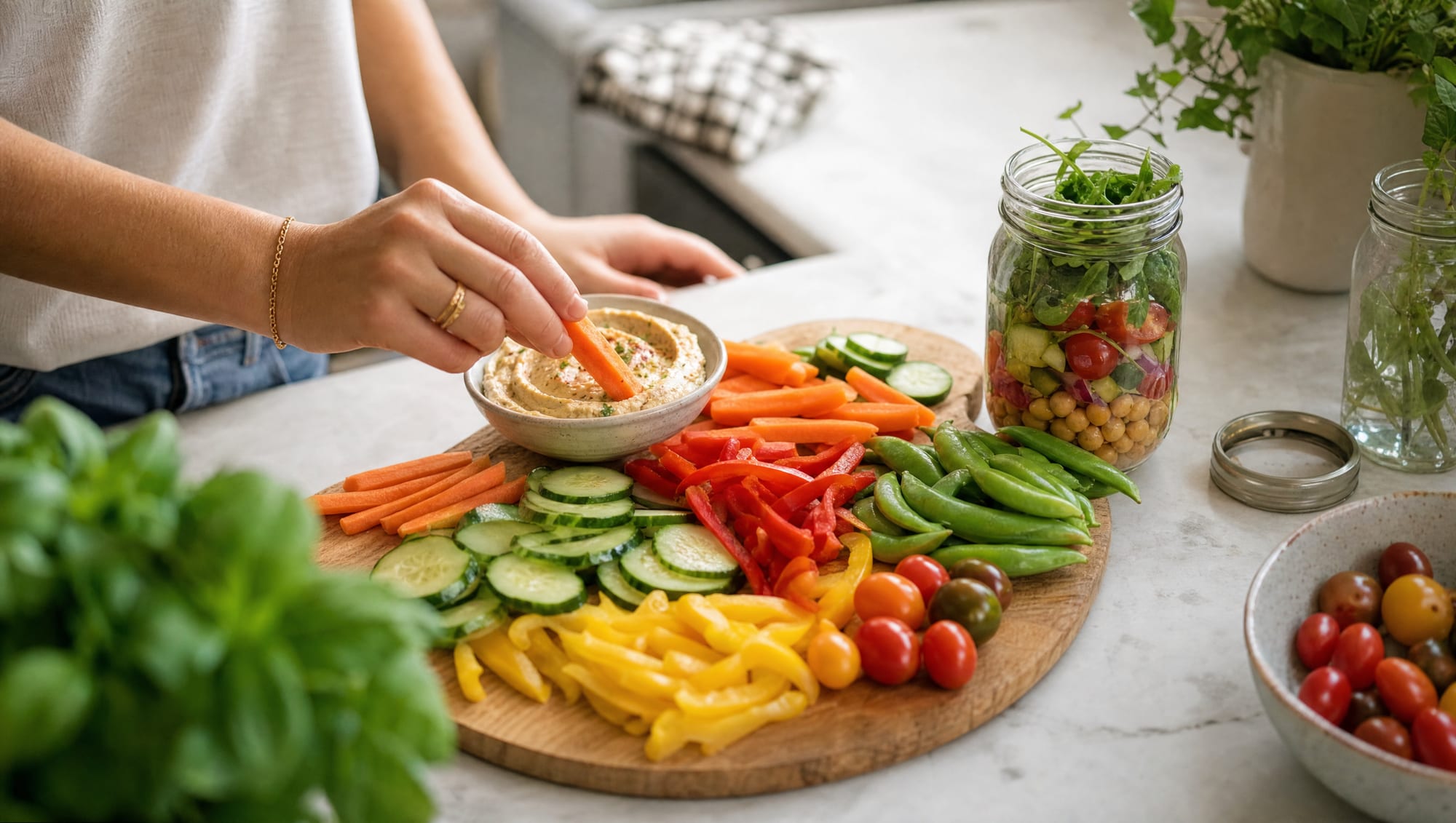
You're training, competing, and trying to eat like it matters. That usually turns the snack drawer into a negotiation instead of a plan. A raw vegetable snack can do real work here, but only if it does more than sit there looking virtuous. What you want is fuel that fits a run, a lift, a league night, or a long workday where you still need something left in the tank.
Raw vegetables fit the broader snacking picture cleanly. Federal dietary guidance treats snacks as a chance to add nutrient-dense foods like vegetables, fruit, nuts, and plain yogurt rather than empty calories. Harvard's Nutrition Source frames smart snacking as something filling without tipping into a second meal, and points to a rough target of about 150 to 250 calories per snack. That is the lane this list stays in. Not rabbit food. Not a lunch replacement. Just usable fuel.
1. Veggie and hummus plate
This is the easiest raw vegetable snack to make feel like food. Carrots, celery, bell peppers, cucumber, cherry tomatoes, and snap peas give you crunch and volume, while hummus brings the fat and protein that plain vegetables lack on their own. That mix tends to sit better than heavier snacks before or after training, and it still keeps you satisfied.
A plate like this works best when you prep it once and stop overthinking it. Sunday tray prep is boring, but it decides whether you eat the vegetables or watch them wilt in the crisper drawer. For active people that convenience is part of performance. If the snack is ready, you reach for it before a workout instead of grabbing whatever is closest.
Setup that holds up in real life
- Use sturdy vegetables first. Carrots, celery, peppers, and cucumbers travel better than delicate greens.
- Keep the hummus portion small. That keeps the snack light enough for pre-workout use.
- Season the hummus. A little sea salt or za'atar pays off more than another sugary dip.
- Time it. Thirty to sixty minutes before activity is the cleanest window if digestion matters to you.
If you run or ride after work, this is the snack that doesn't make you feel heavy. It fits the kind of simple eating that supports a training week without turning dinner into a recovery chore. For more runner-focused context, the fuel mindset lines up with how to be a better runner.
2. Mixed vegetable crudites with yogurt dip
Crudites sound fancy. They aren't. It is a crisp vegetable spread with a yogurt-based dip, and that is exactly why it works. Radishes, jicama, fennel, broccoli florets, cauliflower, zucchini, and asparagus give you different textures, which helps when you're bored of the same carrot-stick routine.
Greek yogurt changes the equation. It keeps the snack lighter than a creamy restaurant dip while still adding protein and a little richness, so the vegetables feel like a real break rather than a punishment. That matters after a hard session, especially when you want something refreshing that doesn't drag you down.
Make the dip a few hours ahead so the herbs wake up, then cut the vegetables close to serving so they stay crisp. If you're packing for a team lunch, small separate ramekins stop the dip from vanishing before anyone touches the vegetables. Keep the dip cold and the vegetables dry. Soggy crudites are what happens when convenience wins too early.
3. Crunchy vegetable salad jar
A salad jar is the easiest way to turn raw vegetable snack prep into something you grab and go. The order matters. Dressing goes on the bottom, firm vegetables like cucumber and carrots sit above it, and leafy greens stay on top so they don't wilt before lunch. That simple layering is what keeps the jar worth eating.
For athletes the appeal is predictability. A jar like this tastes the same from one day to the next, which makes it easier to keep in rotation when training already hands you enough variables. Olive oil vinaigrette with cucumber, carrot, red bell pepper, spinach, and hemp seeds is a straightforward build. Tahini with shredded beets, sunflower seeds, kale, and radishes gives you a deeper, earthier version. Lemon dressing with zucchini, cherry tomatoes, chickpeas, and mixed greens works when you want something brighter.
The trade-off is simple. The more delicate the vegetable, the faster it breaks down, so a jar that sits too long turns soft around the edges. Let the structure do some of the work:
- Dressing first. It forms a barrier between the liquid and the vegetables.
- Hardy vegetables next. Carrots, peppers, and cucumbers hold their texture well.
- Tender greens on top. They stay crisp longer that way.
- Make several at once. A few ready jars cut the odds you skip the snack entirely.
This is the jar I'd pack for travel, long office days, or a tournament where real food is hard to find. It gives you structure without needing a kitchen. The same repeatable discipline shows up in how to set fitness goals, because the win is usually the routine, not the perfect meal.
4. Vegetable sticks with nut butter dip
This is the version to reach for when you want vegetables plus something more substantial. Carrot, celery, bell pepper, and cucumber all work with almond butter, peanut butter, or tahini thinned into a dip. You get the crunch of the vegetables and the staying power of the nut butter, which makes it better for hunger control than plain sticks alone.
Nut butter gives the snack a denser feel, so it can carry you between sessions when a full meal isn't happening. A little honey or maple syrup smooths the flavor without turning it into dessert. That said, I wouldn't use this right before hard activity if your stomach is touchy, since it sits heavier than hummus or yogurt.
Texture matters more than people think. If the nut butter is too thick it clings to the spoon instead of the vegetable. Thin it with a little hot water and it becomes something you can actually use. Pack the dip separately and combine it when you eat, because nobody enjoys a limp cucumber that has been sitting in almond butter for an hour. Use this one for steady energy, not a sprint. It is a better mid-afternoon bridge than a last-minute pre-workout fix.
5. Lettuce wraps with raw vegetable fillings
When you need something you can eat fast between sessions, lettuce wraps fit the job. Butter lettuce, romaine, and iceberg all work, but sturdier leaves hold up better because they don't collapse once you load them. Shredded carrot, cucumber, bell pepper, sprouts, and radishes bring the raw crunch, then cottage cheese, tuna, or tofu adds the protein that makes the snack more than a pile of vegetables.
That mix makes sense for a lower-carb option that still feels like real food. It carries easily, it hydrates, and it works after training when you're not ready for a full meal. The catch is moisture. Add too much wet filling and the wrap turns messy fast, so dry the leaves well and spread a thin layer of dressing or cottage cheese to hold everything in place.
- Butter lettuce with carrot, cucumber, and cottage cheese. Soft, cool, and easy to eat.
- Romaine with tuna salad, bell pepper, and sprouts. More structured, better as a post-workout lunch.
- Iceberg with tofu, radishes, and herbs. Crunchier and a little more refreshing.
This is the snack that helps you stay on plan without making food a project. It needs no reheating, it travels well, and it avoids the sugar spike that can throw off your appetite later. It also fits the habit side of competition, where clear fitness goals make it easier to choose food that matches your training instead of reacting to hunger.
6. Pickled vegetable snack box
Pickled vegetables give you a different lane from the usual raw crunch. Cucumbers, carrots, peppers, onions, and radishes all take well to vinegar, salt, and spices, and the result is sharp, salty, and more interesting than another plain tray of sticks. If you bore easily, this is the snack that keeps raw produce from feeling repetitive.
The best part is how little last-minute work it needs. Quick-pickled vegetables are a strong fridge snack because the flavor is already built in. Fermented versions go further but ask for patience before they're ready. Keep everything in glass jars with tight lids so the texture and flavor stay where you want them, and don't rush a ferment and then complain the cucumbers taste flat. They're not supposed to be instant.
- Quick-pickled carrots and daikon with ginger and turmeric. Bright and punchy.
- Fermented cucumbers with dill, garlic, and black pepper. Classic and strong.
- Mixed peppers, onions, and jalapenos. Better when you want heat.
This is a smart snack for anyone who wants something bold without opening a bag of chips. It is also useful around meals, because a tangy bite can reset your appetite without pushing you into a second dinner. In a real training week, that kind of snack control matters more than people admit.
7. Raw vegetable rainbow bowl with nuts and seeds
A rainbow bowl is the most complete raw vegetable snack on this list. It brings together red tomatoes, orange carrots, yellow squash, green spinach, purple cabbage, and white cauliflower, then adds nuts, seeds, and a light vinaigrette. The result is part crunch, part freshness, part staying power.
The reason it works is balance. Raw vegetables bring volume and micronutrients, nuts and seeds add texture and richness, and a vinaigrette keeps the bowl from feeling dry. That combination is ideal when you have a little more time after a workout and want to refuel before jumping into a heavy meal.
Keep the build simple so it repeats. A spinach base with shredded carrots, bell peppers, sunflower seeds, and lemon vinaigrette is easy to remake. Mixed greens with purple cabbage, yellow squash, cherry tomatoes, pumpkin seeds, and tahini dressing gives you a more layered version. Arugula with grated beets, fennel, walnuts, flax, and balsamic is the one I'd use when I want something sharper and less sweet. Dress it right before eating so the vegetables stay crisp.
If you use MoveTogether to keep a weekly training streak intact, this kind of snack follows the same logic as steady effort and steady prep. The habit of assembling simple bowls also pairs well with low-calorie oatmeal recipes, since both reward consistency over cleverness.
The seven snacks at a glance
| Snack | Best for | What it gives you |
|---|---|---|
| Veggie and hummus plate | Quick grab-and-go fueling before or after a workout | Fiber, moderate protein, hydration, fast to assemble |
| Crudites with yogurt dip | Competition days and social snacking | Light protein, a lower-calorie creamy dip, varied textures |
| Crunchy salad jar | Meal prep, weekdays, travel | Portable balance that holds its crunch when layered well |
| Sticks with nut butter dip | Steady energy between sessions | Healthy fats and protein, high satiety |
| Lettuce wraps | Lower-carb, mid-training bites | Handheld protein, hydrating, easy to eat |
| Pickled vegetable box | Batch prep and appetite reset | Bold flavor, long fridge life, and probiotics if fermented |
| Rainbow bowl with nuts and seeds | Post-workout recovery, a fuller mini-meal | Broad micronutrients, healthy fats, satisfying volume |
Fueling is part of the competition
The takeaway is simple. Consistency wins. You can have a solid training plan and a serious competitive streak and still lose ground if your snacking is random. A good raw vegetable snack isn't about eating “healthy” in the abstract. It is about making the next session easier to start, easier to finish, and easier to recover from.
That is why the options here all pull double duty. They give you crunch, fiber, water, and nutrients, and they fit real life. Hummus plates are fast. Crudites feel fresh. Salad jars travel. Nut butter dips hold you over. Wraps feel like a meal without the heaviness. Pickled vegetables keep things interesting, and rainbow bowls bring it together when you have a few extra minutes.
Raw vegetables earn their place in the bigger nutrition picture too. Federal dietary guidance counts them among nutrient-dense snack choices, and Harvard's guidance points to snacks that fill you up without overshooting on calories. There is a real raw-versus- cooked trade-off, since some nutrients become more available with cooking and others hold up better raw, which is part of why the format matters and not just the ingredient.
If you want competition to stay fun, make fueling part of the routine. Eat the snack that fits the session, not the one that looks best on a feed, then carry that same consistency into your workouts, your recovery, and your leaderboard goals. MoveTogether's leagues are a simple place to put that consistency to work.
MoveTogether turns habits like smarter snacking and steady training into something you can measure. It brings your activity data into one place and makes competition feel less random and more useful, so the prep you do off the clock actually shows up on the board.
Nutrition guidance here is general and not medical or dietary advice. Check with a professional for needs specific to you.