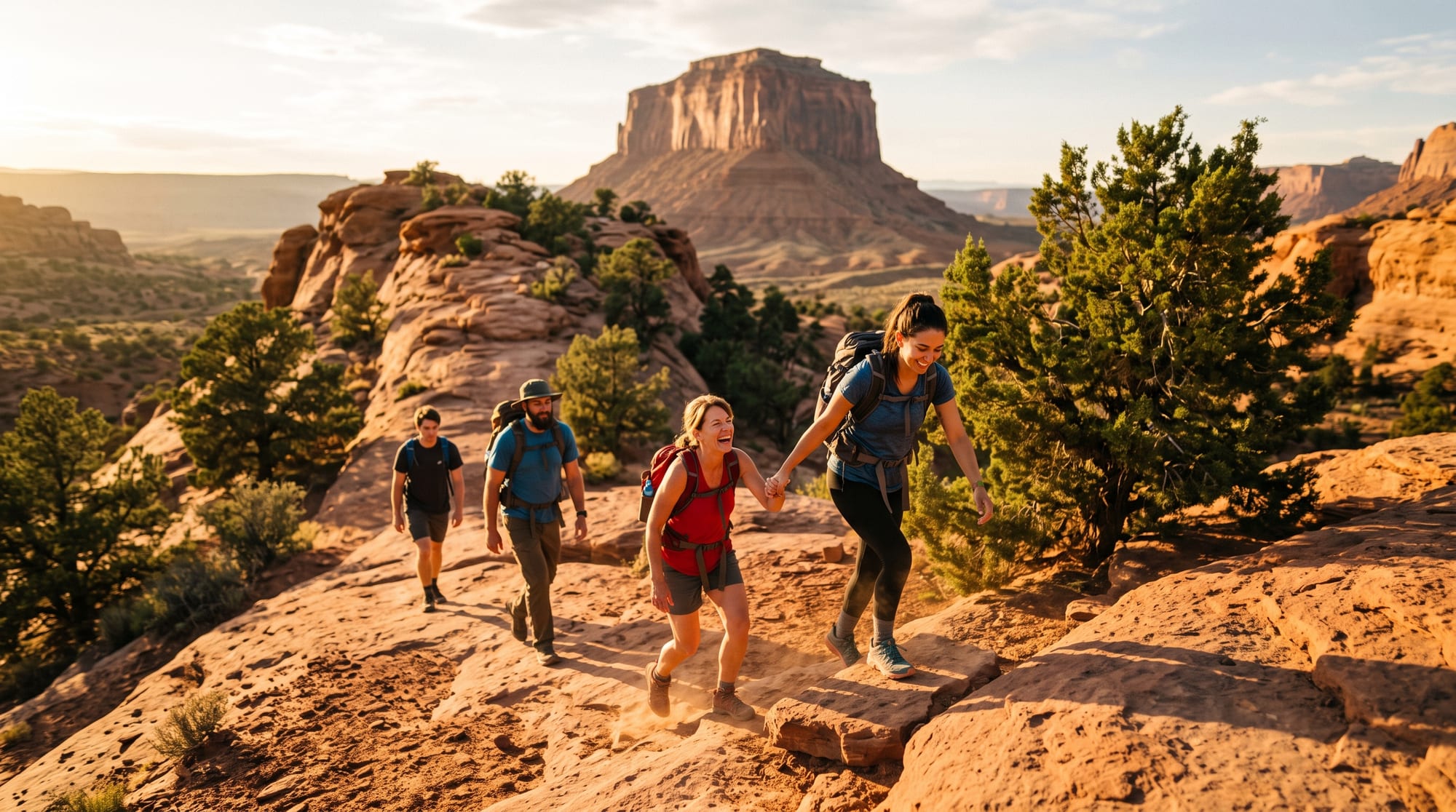
Your group picks Sedona for the views. The trouble starts when one friend logs with a Garmin, another closes Apple Watch rings, and someone shows up with just an iPhone. Choosing the hike is easy. The scoring is where it usually falls apart.
MoveTogether was built to fix that. It reads activity from Apple Health, Garmin, Fitbit, WHOOP, Oura, Strava, and Polar, and it supports iPhone-only onboarding through Apple Health without a wearable, as covered in the MoveTogether FAQ. That matters on trail days, because mixed devices can turn a fun group challenge into an argument about whose app counted more effort.
Sedona gives you plenty to work with. From June 2022 to May 2023, the Red Rock Ranger District trail system around Sedona and the Village of Oak Creek recorded an estimated 2,223,804 recreational trail users. Popular routes are busy, conditions vary, and GPS results can get messy fast. That is exactly why trail competition rules need to fit the route instead of assuming every hike should be scored by raw time.
So these are not just good Sedona hikes. They are good places to run a fair, fun competition with friends across Apple Watch, Garmin, Fitbit, and iPhone. Some reward step-based scoring. Some are better for consistency or effort-based scoring. Some need a clear turnaround point agreed before anyone starts. Groups training for longer efforts already know this trade-off from cross-country running workouts and pacing strategy. Trail competition works the same way.
Here are nine Sedona trails I would use for a group challenge, and the scoring format I would choose for each one.
1. Cathedral Rock Trail
Cathedral Rock looks manageable from the lot. Ten minutes later, one person is in trail runners moving fast, another is stopping at every steep step, and someone wants to race the whole thing. That gap is why this trail needs clear rules before anyone starts.
Score Cathedral Rock on effort, not finish time. The route is short, steep, and interrupted by scrambling, so pace data gets noisy fast across Apple Watch, Garmin, Fitbit, and iPhone tracking. MoveTogether helps here because you can keep the contest fair even when your group logs on different devices.
Best competition format
Use a goal everyone understands. Ring Close Count or Percentage of Goals both reward the day's activity, including the intensity of a climb, without turning one rocky scramble into a GPS argument. Pick a fixed turnaround point and score effort, not who attacks the scramble hardest. The strongest climber still has an edge, but newer hikers stay in it.
A recurring benchmark works well here. Run it once a month, keep the start time similar, and keep the turnaround point identical. Then compare progress instead of one-off hero efforts. If your group wants a repeatable challenge, set the same route rules each time and agree on realistic goals for the group before you ever open the leaderboard.
- Start early. Bottlenecks form on the steep sections, and waiting time makes comparisons less clean.
- Wear proper shoes. Grip matters more here than mileage.
- Bring water. The rock holds heat and shade is limited.
- Lean on Coach Mo before the climb. A well-timed nudge gets hesitant friends out the door, which is half the battle on short but punchy hikes.
2. Devil's Bridge Trail
Reach the bridge and everything slows down. One friend wants the photo. One wants to keep moving. Another is checking whether their Apple Watch matched their Garmin distance from last time. Devil's Bridge still works well for a group challenge if you set the rules before anyone leaves the parking lot.
The route is clear and the objective is obvious, and the effort feels real without forcing everyone into a scramble. That makes it a good pick for fair competitions across mixed devices. Apple Watch, Garmin, Fitbit, or a plain iPhone can all sit in the same challenge if you score the day the right way.
What works and what doesn't
I would not score this one by finish time. Crowds, photo lines, and small route differences swing the result more than fitness does. Score total effort instead. Raw Numbers usually works well, and Percentage of Goals is a better call if your group hikes at different paces but still wants a contest that feels earned. Treat Devil's Bridge as a repeatable social benchmark, not a race to the arch. Set one start window, agree on whether the photo stop counts, and decide whether post-hike activity counts toward the day's total.
- Start early. You avoid heat, traffic, and waiting near the bridge.
- Pick one scoring format. Raw Numbers or Percentage of Goals make cleaner comparisons here.
- Set the rules before the hike. Nobody should be arguing about the format afterward.
- Carry enough water. The exposed sections make this feel harder on warm days than the mileage suggests.
3. Bell Rock Pathway
Bell Rock Pathway handles mixed goals better than almost any other Sedona option. One person wants a real hike, one brought kids, and one only has a phone in their pocket and no interest in scrambling up slickrock. The trail gives you multiple natural turnaround points, wide-open views, and enough route choice to keep stronger walkers from getting bored without trapping newer hikers on something too hard.
Why Bell Rock works for inclusive leagues
This is a strong pick for competitions built around consistency rather than suffering. Use Head to Head on steps or Percentage of Goals if your group plans to spread out, start from slightly different access points, or choose different distances. Those formats give casual hikers a fair shot while still rewarding the friend who wants to keep going. The trade-off is simple: Bell Rock is less useful if you want the trail itself to decide the winner. The terrain is too forgiving for that. For a mixed-device, mixed-fitness competition, that is a strength.
- Use it as your baseline trail. It works well for the first event in a new hiking league.
- Score consistency, not speed. That keeps the route fair for kids, older relatives, and casual walkers.
- Set route options before anyone starts. Full loop, out-and-back, or a time-based turn can all work if the rule is clear.
4. West Fork Trail (Oak Creek Canyon)
West Fork is what I would choose when the group wants a longer day out without turning the whole thing into a sufferfest. The canyon scenery does a lot of work. Shade helps. Creek crossings keep it interesting. The flexible turnaround makes it useful for groups that do not all want the same mileage.
Timing matters as much as the trail on a route this popular. Sedona stays busy through the spring, and trailheads for well-known hikes like West Fork fill early on peak days, so an early start or an off-season visit means fewer crowds and cleaner comparisons.
Best format for mixed-ability groups
West Fork works best when you do not force everyone into one exact distance. Pick a time window instead. Ninety minutes out and back, or a half-day where everyone accumulates as much as they can responsibly manage. That lets stronger hikers go longer while newer hikers stay part of the event. I would use Raw Numbers or Head to Head on steps here. The point is sustained movement, not who can surge hardest on a climb.
- Expect wet feet. Creek crossings are part of the deal.
- Pick a turnaround rule first. Time-based works better than distance-based for mixed groups.
- Watch for bugs in warmer weather. Creekside hikes come with trade-offs.
- Use iPhone-only tracking if needed. Not everyone needs a watch to count on the board.
5. Courthouse Butte Trail
Courthouse Butte is one of the cleaner picks in Sedona for a fair benchmark hike. One person wears an Apple Watch, another uses Garmin, and someone forgot their watch and is tracking on an iPhone. The route is scenic, steady, and easier to repeat than the flashier trails, which matters if you want a monthly challenge that does not turn into an argument about trail traffic or who had to stop at a chokepoint.
A strong choice for repeat events
Courthouse Butte works best as a consistency trail. Pick one route, keep the rules fixed, and compare effort across time rather than finish speed. I would usually score it on Percentage of Goals or Ring Close Count. Pace alone skews the result too hard on a moderate loop like this. A faster hiker still has an edge, but the person who manages the whole outing well stays competitive. It also works for self-comparison: on a stable trail, better pacing and fewer long stops actually show up.
- Start early or go late. Midday sun makes this trail feel harder than it needs to.
- Use the full loop on benchmark days. Shortcuts make the comparison weak.
- Set the scoring rule before anyone starts. Changing formats after the hike always feels unfair.
6. Schnebly Hill Road (scenic drive and walking route)
Schnebly Hill suits a mixed group on a long weekend. One friend wants a real workout, one brought kids, and one only has an iPhone and does not care about pace splits. The road gives you flexibility. You can walk a shorter out-and-back, set a time limit, or use a fixed turnaround. The views still feel like Sedona and the effort stays manageable.
Where Schnebly fits
Use Schnebly for recovery weeks, family trips, and low-stakes competitions that still count. Scoring needs to match the trail: a hard-climb mindset breaks this one. Head to Head on steps or Raw Numbers works better than pace, because cars, photo stops, and uneven turnaround choices distort speed-based results fast. One person can push the uphill sections and treat it like active recovery. Another can walk steady, take in the scenery, and stay competitive if the rules reward consistency instead of speed.
- Start early. You will deal with less heat and less vehicle traffic.
- Choose the route in advance. A fixed distance makes friend-to-friend scoring cleaner.
- Use simple metrics. Steps or total movement fit this route better than chasing fast splits.
- Treat it as a participation trail. Good competition design keeps lighter days in the season, and recovery weeks are often where streaks fall apart.
7. Soldier Pass Trail and Seven Sacred Pools
Reach the pools and the usual problem shows up. One person wants to push the pace to the cave junction, one is stopping for photos, and one forgot to charge a watch and is tracking on an iPhone. Soldier Pass handles that mix better than a lot of Sedona hikes. It has enough variety to stay fun, but it usually does not turn into a pure fitness test, which matters if you want a fair contest instead of a result that just rewards the strongest climber.
Best for repeat efforts with fair scoring
I like Soldier Pass for benchmark days. Repeat the same turnaround, use the same scoring rule, and compare efforts over time. That works with MoveTogether whether your friends use an Apple Watch, Garmin, Fitbit, or just their phones, because the goal is to compare the day fairly instead of arguing over whose device measures the trail “right.” If your group uses pace, photo stops and short bottlenecks can skew the outcome, so Raw Numbers or Head to Head on steps usually holds up better here.
- Set one turnaround point before you start. That keeps the competition clean.
- Use distance, steps, or total output over pace. Stops and crowding distort speed-based results.
- Treat the return as part of the test. A lot of hikers go out too hard here.
- Repeat it monthly if your group likes tracking progress. The route is memorable enough to compare effort, not just finish times.
8. Fay Canyon Trail
Fay Canyon is the quieter friend in this list. It does not have the loud reputation of Cathedral Rock or Devil's Bridge, and that is part of why I like it. You can use it for a clean benchmark without the whole day turning into a parking and crowd-management exercise. For newer groups it is a strong on-ramp. It feels like a real hike without demanding the confidence of a harder scramble.
Best used as part of a bigger day
Fay Canyon fits a two-hike Saturday. Do Fay in the morning, then add an evening walk, an easy spin, or another short trail. That is where Percentage of Goals or Raw Numbers starts to shine, because one trail does not have to carry the whole competition. It is also a good route for building consistency without turning every outing into a max-effort test. Use Ring Close Count if your group likes Apple-style behavior goals.
- Use it as a confidence builder. Especially for newer hikers joining an established group.
- Pair it with another activity. The trail is short enough that this works well.
- Keep water on hand. Exposed sections still add up.
- Save it for crowded weekends. Sometimes the smart trail is the one with less friction than the bigger names.
9. Munds Mountain Trail
Reach the junction and the tone changes fast. The casual chatter drops off. Munds Mountain asks for steady climbing, better footing, and a group that agreed to a hard day before leaving the parking lot. That makes it useful for competition, but only if the format is fair.
Munds works best as a designated challenge trail for the strongest hikers in your group, not as the default Sedona pick for everyone. The route puts more weight on climbing strength, pacing, and heat management than a simpler trail does. If one friend is fit, one is cautious on exposure, and one is just visiting with an iPhone in a backpack, raw step totals turn into a bad scoring system.
Use a scoring format that matches the climb
Score effort here. Ring Close Count or Percentage of Goals reflect a hard climb better than steps, because both credit the intensity of the effort rather than the number of paces. That matters if you are trying to make one leaderboard work across Apple Watch, Fitbit, iPhone, and Garmin-connected hikers. The goal is to reward the work, not just the person whose device counts movement most generously on steep terrain. I would save Munds for a monthly peak challenge inside a broader league, and keep the regular events more inclusive.
- Start early. Heat changes this hike more than people expect.
- Carry extra water and electrolytes. Long climbs punish sloppy planning.
- Wear shoes with real grip. Loose rock gets worse on tired legs.
- Check the weather before you go. Wind and rain make the route less forgiving.
- Set expectations at the trailhead. Agree on scoring, turnaround points, and whether this is a pace challenge or just an advanced group effort.
The nine trails at a glance
| Trail | Difficulty | Scoring method I would pick | Why it fits |
|---|---|---|---|
| Cathedral Rock Trail | Short, steep, some scrambling | Ring Close Count or Percentage of Goals | Rewards effort without a risky speed race on rock |
| Devil's Bridge Trail | Moderate, longer, steady terrain | Raw Numbers or Percentage of Goals | Iconic, consistent route for a fair benchmark |
| Bell Rock Pathway | Easy, mostly flat, flexible | Head to Head on steps or Percentage of Goals | Beginner-friendly and good for mixed ability |
| West Fork Trail (Oak Creek Canyon) | Moderate, long, creek crossings | Raw Numbers or Head to Head on steps | Shaded canyon, flexible distance for endurance days |
| Courthouse Butte Trail | Moderate loop, steady incline | Percentage of Goals or Ring Close Count | Repeatable loop for clean month-to-month comparisons |
| Schnebly Hill Road | Easy to moderate, flexible | Head to Head on steps or Raw Numbers | Low-impact, good for family and recovery weeks |
| Soldier Pass and Seven Sacred Pools | Moderate, scenic with water features | Raw Numbers or Head to Head on steps | Scenic reward that holds up as a repeat benchmark |
| Fay Canyon Trail | Short, quieter, steady ascent | Ring Close Count or Raw Numbers | Quiet on-ramp that pairs well with a second activity |
| Munds Mountain Trail | Hard, long, steep, technical sections | Ring Close Count or Percentage of Goals | Effort scoring keeps a hard climb fair across devices |
Make your next hike a competition
You meet at the Sedona trailhead and the debate starts right away. One friend wants fastest time, another wants total steps, someone with a Garmin wants effort to count, and someone else forgot their watch and only has an iPhone. If you do not set the format before the first mile, the results feel arbitrary by the end.
Sedona is a good test case because the trails vary so much. Bell Rock, Courthouse Butte, and West Fork are better for steady scoring and repeat matchups. Cathedral Rock and Munds reward climbing effort more than pace. On crowded routes or trails with scrambling, a pure time-based contest breaks down fast. Match the scoring to the route, and a fair contest on Bell Rock does not become a bad contest on Cathedral Rock.
MoveTogether solves the device problem. Apple Watch, Garmin, Fitbit, and iPhone users still end up on the same leaderboard, which matters if your goal is a real group competition instead of six separate fitness logs no one agrees how to compare. It also has clear limits. MoveTogether is for the shared competition, standings, and accountability. It is not your mapping app, route finder, or backcountry safety tool. Use the hiking app you already trust for navigation, and use MoveTogether to keep the scoring fair across mixed devices and mixed fitness levels.
The simplest format usually wins. Pick one accessible trail where everyone can take part, pick one harder trail for the friends who want a tougher test, and choose the scoring method in the parking lot, before anyone presses start, so nobody rewrites the rules after the hike. If you want to try it with your group, check Android availability and compare plans on the pricing page. Download MoveTogether and start competing, with an optional Pro tier.
Third-party device, platform, and place names belong to their respective owners. Trail distances and difficulty are approximate; check current conditions and your own limits before you go. MoveTogether is available on iOS and Android.