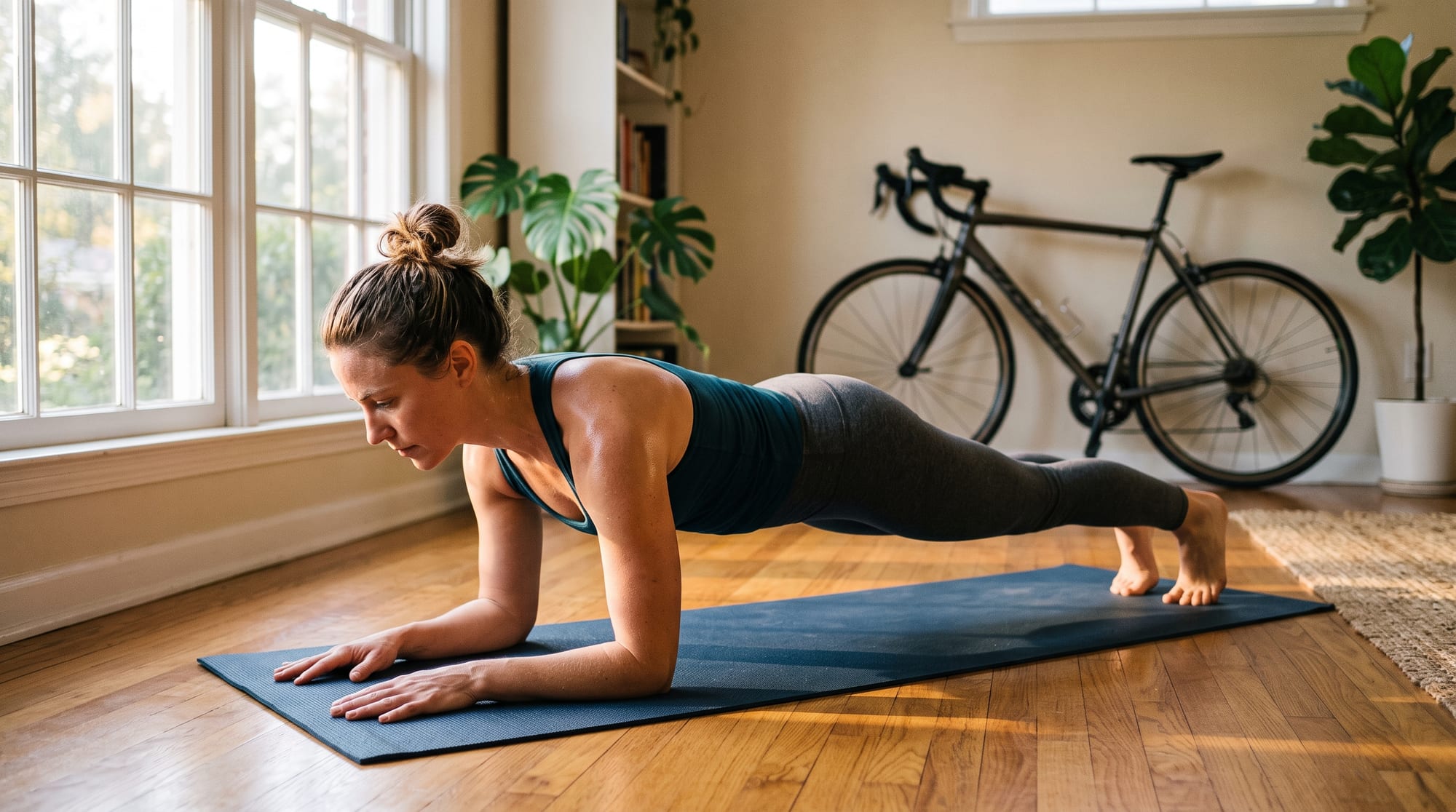
You can have the strongest legs in the room and still lose power on every pedal stroke. If the torso above those legs is wobbling, force that should go into the cranks leaks out into your back, your shoulders, and a lot of tiny corrections you never notice until the end of a long ride.
A strong cycling core is not about a six-pack. It is a stable platform that lets your quads and glutes actually reach the pedals. On the bike, the core works mostly as a stabilizer, not a prime mover, which is exactly why short off-bike sessions matter so much for posture, comfort over distance, and holding your line when the effort gets messy.
We see the same thing in MoveTogether every week. Riders who stay consistent with short, slightly boring core sessions tend to hold form longer and stack better training weeks. That steadiness usually does more for your Move Leagues standing than the occasional hero day. Here are the seven moves I think earn their place, and the honest case for each.
1. Planks
Halfway up a hard climb, posture is usually the first thing to go. The bars start getting tugged side to side, the ribs flare, and the effort feels sloppier than the numbers say it should be. A good plank trains the opposite: hold your shape, and keep force pointed into the pedals instead of wasting it on upper-body motion.
Why planks earn their spot
Planks look basic, but for cyclists the value is anti-extension strength. You are teaching the trunk to resist sagging through the lower back while the shoulders and hips stay connected. Out of the saddle, that lets you drive the bike without folding through the middle. On long rides, you notice it as less low-back fatigue rather than a dramatic jump in power.
Form matters more than the clock:
- Elbows under shoulders. This keeps the load off your neck and upper traps.
- Ribs down. A flared ribcage usually means you have stopped bracing and started hanging on your spine.
- Glutes lightly on. That keeps the pelvis neutral, the position most riders lose first under fatigue.
- Short and clean beats long and shaky. Twenty honest seconds does more than a wobbly minute.
For most riders I would start with three to five sets of 15 to 30 seconds, and add time only if the position stays sharp. If standard planks feel easy, use a smaller base of support or add a reach rather than just chasing a longer hold. The same trunk control carries over to other endurance sports too, which is why this ab workout for runners and cross country running training lean on the same basics.
2. Dead bugs
Dead bugs look easy. Then you do them properly and find out they are not. That is exactly why I like them. They teach you to keep the trunk stable while your arms and legs move independently, which is a lot closer to real riding than lying still and holding tension.
The real benefit is control under motion
Plenty of riders can brace for a few seconds. Fewer can keep that brace while slowly moving a limb without letting the lower back arch. If your back takes over every time your legs push, dead bugs expose it fast. Move slowly, press the low back gently into the floor, and extend only as far as you can hold position. The second your lower back lifts, the rep is over, whatever the timer says.
Treat this as motor-control work, not ab burn. Breathing is part of it: keep breathing steadily through each rep instead of holding your breath to fake stability. A few cues that help:
- Move the opposite arm and leg. That cross-pattern maps neatly onto pedaling rhythm.
- Add a brief pause at full extension so you have to own the position.
- Progress by tempo, not by piling on reps. Slower is usually harder and better.
3. Bird dogs
Bird dogs do not look like much, and that is part of the point. They strip away momentum, so you cannot cheat if you do them with control. For cyclists they sit in a useful middle ground, training hip extension, shoulder stability, and trunk control at the same time.
Better than they look
Think about the power phase of a pedal stroke. The hip drives while the torso stays quiet. Bird dogs rehearse a version of that pattern without loading the spine much, which also makes them a good reset for anyone who sits all day and then jumps straight onto the bike.
Where riders usually go wrong
- Reaching too high with the leg, which turns the rep into low-back extension.
- Twisting through the torso, which defeats the anti-rotation part.
- Rushing back to the floor. The return matters as much as the reach.
Use a short hold at full extension and keep the hips square. If you wobble, shrink the range. That is not a step back, it is better training. I like bird dogs for gravel riders and mountain bikers in particular, because uneven terrain punishes anyone who cannot stay stable while the bike moves underneath them.
4. Russian twists
Russian twists are useful, but they need context. I would not build a whole cycling core plan around them. Cycling mostly asks you to resist rotation rather than create it, so this is a supporting move, not the star.
Use them carefully
If you ride technical trails, corner hard, or want better upper-body awareness on rough surfaces, Russian twists can help. They wake up the obliques and teach you to control side-to-side torso movement. The trade-off is that riders with cranky lower backs often force range they do not own, and the twist turns into lumbar irritation instead of training.
- Use light resistance. Heavy loading usually makes form worse, not better.
- Rotate through the torso, not the low back. The movement should feel controlled, never yanked.
- Pair it with anti-rotation work. Twisting alone is not enough for cyclists.
A lot of current coaching for cyclists has shifted toward anti-rotation and dynamic stability, because it matches the uneven forces you actually deal with in wind, cornering, and imperfect roads. Rotational work still has a place. Just do not let it crowd out the drills that keep you steady.
5. Bicycle crunches
Bicycle crunches are popular because they are accessible. Everyone knows them, and you can do them anywhere. That does not make them the best choice for every rider. I keep them on the list, just not near the top.
Good finisher, weak foundation
If bicycle crunches are your main core plan for cycling, you are probably underdosing the work that matters most. Cycling does not lean on repeated spinal flexion. It leans on stiffness, control, and staying organized under fatigue. That said, bicycle crunches can build general trunk endurance, and they are simple enough to tack onto the end of a short home session when you want extra abdominal work without equipment.
Treat them like accessory work:
- Use them late, after your stability work rather than before it.
- Chase control, not speed. Fast reps turn messy and start pulling on your neck.
- Skip them during back flare-ups. They are not worth fighting through pain.
6. Pallof presses
Pallof presses are one of the best cycling core moves if your goal is to stop leaking force side to side, and they are not flashy, which is usually a good sign. A band or cable tries to twist you, and your job is to refuse. That is about as cycling-specific as a core demand gets.
The move most riders are missing
Plenty of core plans still lean too hard on crunches and long static holds. What riders actually need is to keep the hips square, the ribcage stacked, and the torso calm while force moves through the limbs. A clean Pallof press teaches exactly that:
- Set the band at chest height for the cleanest line of pull.
- Press slowly. The press-out is where most riders start rotating.
- Own the return. Letting the band yank you back wastes the rep.
A practical starting dose is a couple of short sessions a week, around three sets of 10 reps per side with a light band. It also scales nicely. Move farther from the anchor, pause longer, or work from a half-kneeling position as you get stronger. If you already think in terms of adding focused support work around your main sport, this best cross-training guide fits the same philosophy: use the right off-bike tool for the job.
7. Mountain climbers
Mountain climbers are not a pure core exercise, and that is exactly why I still like them. They blend trunk stability with leg drive and a rising heart rate. Done well, they teach you to keep your shape while breathing hard, which is what race day and hard training actually demand.
Best used under fatigue
I would not open a core session with mountain climbers. They are better as a warm-up or a finisher. Early in a workout they pull people into sloppy speed. Later on, they build work capacity without pretending to be precision training. Keep the setup simple: a strong plank line, stacked shoulders, steady hips, and knees driving forward without bouncing your whole body around.
There is a real case for keeping core sessions short and controlled. Coverage in Outside's Velo suggests riders do core work about twice a week, with slow, deliberate reps and beginners often starting with a single set. That same reporting is refreshingly honest about the ceiling: direct efficiency gains from core training are mixed in the research, but as a rider's core fatigues, lateral sway can creep into the knees, so the clearest payoff is injury resilience and holding form, not free watts.
- Slow them down first. Earn speed later.
- Watch the hips. If they shoot up, the rep quality is gone.
- Keep them short. Good bursts beat long, ugly sets.
How the seven moves compare
None of these is a magic exercise. They do different jobs, and a good week usually mixes a stability move, an anti-rotation move, and something that raises the heart rate.
| Exercise | What it trains | Effort to learn | Best used as |
|---|---|---|---|
| Planks | Anti-extension, spinal alignment, endurance | Low | Base builder and pre-ride prep |
| Dead bugs | Anti-extension control while limbs move, pelvic control | Low to medium | Off-bike stability and back-friendly work |
| Bird dogs | Hip extension, glute activation, anti-rotation | Low | Activation before rides, pedal-stroke transfer |
| Russian twists | Oblique strength, controlled rotation | Medium | A supporting move for off-road and cornering |
| Bicycle crunches | General trunk endurance | Low | A no-equipment finisher |
| Pallof presses | Anti-rotation stiffness, lateral stability | Medium | The cycling-specific move most plans skip |
| Mountain climbers | Core endurance under fatigue, work capacity | Medium | A warm-up or finisher, not precision work |
Sample routines and a few precautions
Knowing the moves is one thing. Repeating them is another. A good starting point is two to three short sessions a week on non-consecutive days. Listen to your body, and if you feel sharp pain, especially in your lower back, stop. Quality beats quantity every time.
Beginner (2 rounds): 30-second plank, 10 slow dead bugs per side, 10 slow bird dogs per side.
Intermediate (3 rounds): 60-second plank, 12 dead bugs per side, 12 bird dogs per side, 10 Pallof presses per side with a light band.
Advanced (3 rounds): 90-second plank, 12 Pallof presses per side with a heavier band, 30 seconds of mountain climbers, 15 Russian twists per side.
It helps to keep expectations realistic. In one study of trained road cyclists, core exercises alone did less for power than conventional strength training, which produced bigger gains across five-second, one-minute, five-minute, and twenty-minute power along with a larger VO2 max improvement, and there was no meaningful body-composition difference between groups, per this road cycling power study. The takeaway is not that core work is pointless. It is that core work is support.
I like short sessions because they are easy to repeat. Most missed core work comes from making the plan too ambitious. Ten clean minutes done regularly beats a complicated circuit you skip for two weeks. If you are using MoveTogether to stay accountable, that kind of consistency is what moves the needle. Better posture and durability on the bike lead to steadier activity across the week, which shows up on your synced wearables when training stops being random.
Where this fits in MoveTogether
MoveTogether scores cross-device competition with seven methods, from Ring Close Count and Percentage of Goals to straight Head to Head on steps and workout-only scoring. Move Leagues run on the same formula as the Friends and Global leaderboards, summing your Move calories, Exercise minutes, and step count divided by 100 across the seven-day week. If your group spans very different devices or fitness levels, Percentage of Goals is the fairest option, because it compares each person to their own goals rather than to the fittest rider. Steadier core work keeps you healthy enough to ride more often, and that consistency usually matters more than one huge day.
Need a nudge or help thinking through your next competition? Ask Coach Mo. Mo can help with strategy and consistency using your real numbers. Mo will not replace actual training programming, and we do not pretend otherwise.
If you want a simple way to turn better training habits into friendly pressure, that is what MoveTogether is for. It brings Apple Health, Google Health/Fitbit, Garmin, WHOOP, Strava, Polar, Oura, Ultrahuman, and iPhone-only activity onto one live leaderboard, with Move Leagues, Coach Mo, and support for mixed-device groups. Download MoveTogether and start competing, with an optional Pro tier. MoveTogether is available on iOS and Android. We think honesty helps more than hype: MoveTogether does not do GPS routes, and it does make shared fitness competition a lot easier.
Third-party device and platform names belong to their respective owners. This article is general fitness information, not medical advice. MoveTogether is available on iOS and Android.